

Why this still trips up good cricket fans
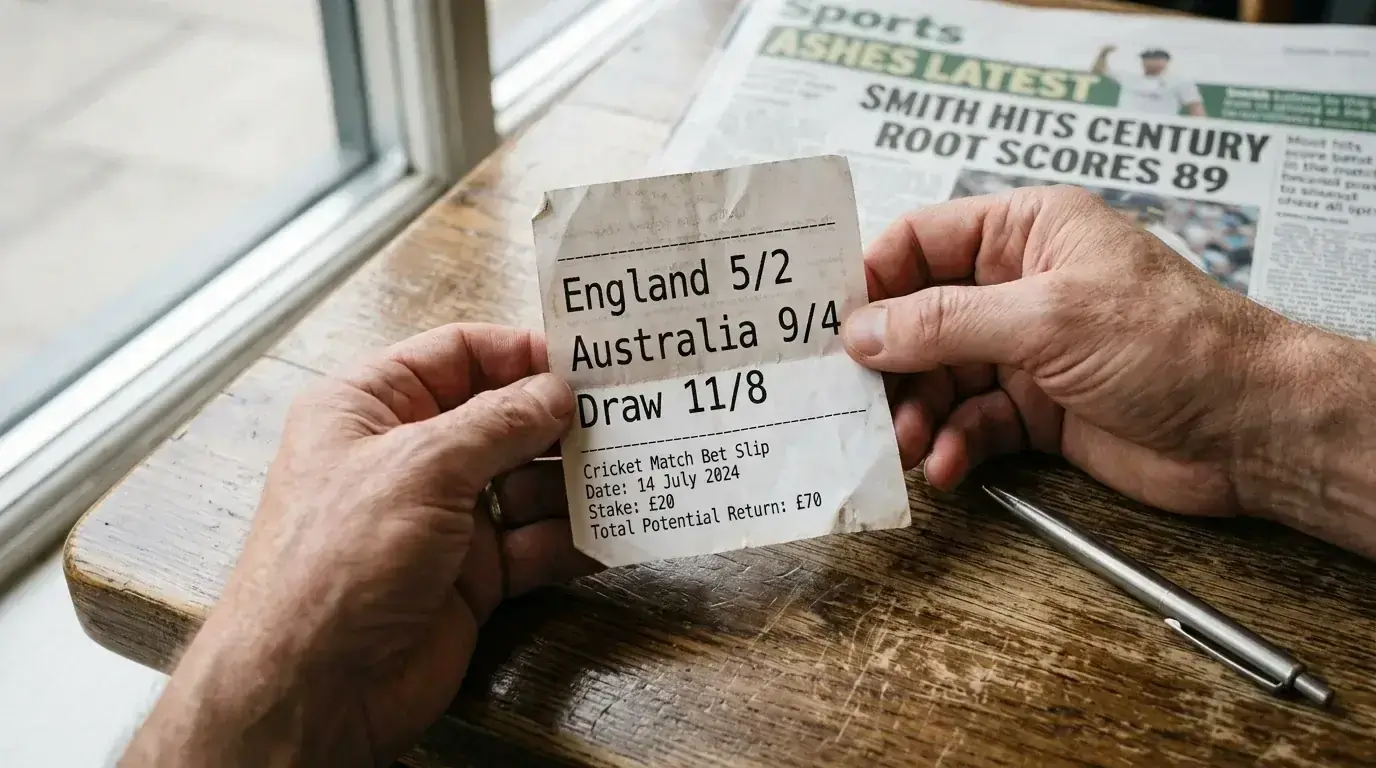
I spent the better part of an Edgbaston afternoon last summer explaining 9/4 to a friend who has watched cricket since the Botham years and never placed a bet. He could read a Duckworth-Lewis chart but couldn’t tell me what England were “priced at” without squinting. That’s the thing about fractional odds in the UK – they’re cultural shorthand for everyone who grew up reading the back pages, and a small wall for everyone who didn’t.
This walkthrough is for the wall-climbers. I’ll show you how a UK cricket coupon actually reads, how to convert between fractional and decimal in your head, and why the same probability looks different on three different sites. By the end you should be able to glance at a Top Run Scorer market and know, within a second, whether 11/4 is doing you any favours.
What 5/2 actually says to you
The fraction is a profit-to-stake ratio. Nothing more. 5/2 means stake two units, win five, and you also get your two back. That’s it. Once that single sentence is in your head, every odds line on a UK cricket page becomes legible.
The numerator is your profit. The denominator is your stake. 9/4 on Joe Root as Top Batsman means a £4 bet returns £9 profit plus the £4 stake – £13 in total. 5/2 on an India series win means £2 returns £5 profit, total return £7. The maths is identical whichever way you slice it.

Where it gets disorienting is the relative size of the two numbers. Anything bigger than 1/1 (Evens) is a market that thinks your outcome is more likely to lose than win. Anything shorter than Evens – 4/5, 1/2, 1/4 – is the bookmaker telling you it’s more likely than not. So 8/13 on Australia in an Ashes Test isn’t an exotic puzzle. It just means stake thirteen to win eight. Profit smaller than stake, because the market thinks Australia win more often than they don’t.
I had to drill this into myself the slow way. The trick that stuck: cover the slash mentally and read it as “for”. 5 for 2. 8 for 13. 4 for 11. Profit for stake. That mental rephrasing strips out the visual oddness of a number like 8/13 and leaves you with the only thing that matters – what you risk and what you win.
Reading a UK cricket coupon
Open any UK-licensed cricket page during a T20 series and you’ll see four kinds of fractions clustered around the same match. Match Winner sits at the top, usually short on both sides because there are only two real outcomes in white-ball cricket – closer to 4/5 against 11/10 than to 9/2 against 16/1. Top Batsman and Top Bowler markets sprawl, because you’re picking one player out of eleven, so individual prices stretch from 7/2 favourites out to 25/1 tail. Method of Dismissal sits in a different visual register – short prices on Caught, longer on LBW, very long on Stumped.
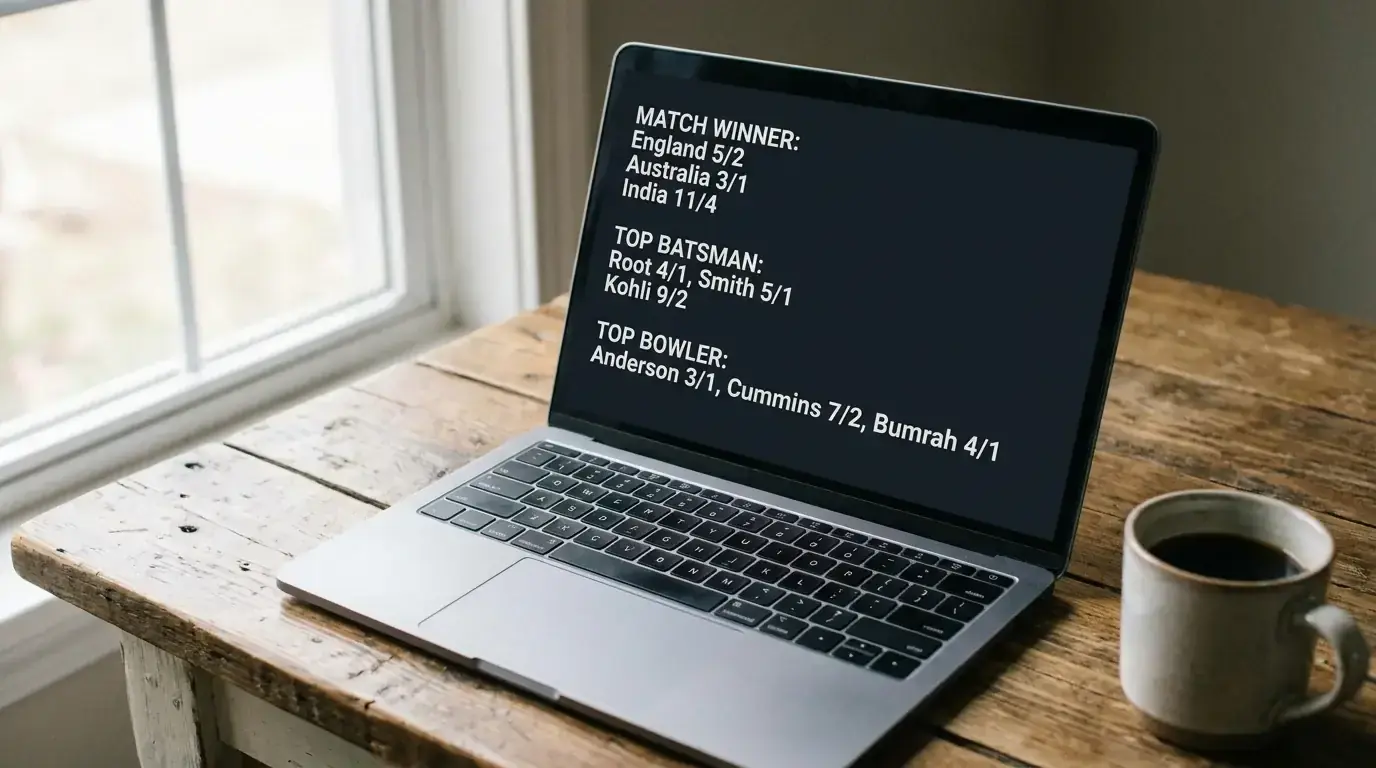
The price you see is the price you get if you click. UK fractional pricing is fixed at the moment of bet placement, which is one reason the format has survived the decimal wave from Europe. You don’t have to do conversion in your head before you stake – the operator does it once your bet is locked.
One small caveat worth flagging. Some sites display the odds in fractional by default but settle internally in decimal, which means a 9/4 that looks clean on screen can return £22.50 on a tenner instead of £22.50 flat – same number, different rounding rules. The remote casino, betting and bingo sector in Great Britain pulled £7.8 billion in gross gambling yield in the year to March 2025, up 13.1% on the previous year, and a good chunk of that infrastructure runs on decimal under the bonnet. The fractional skin you see is mostly UK tradition.
Converting to decimal without a calculator
The whole conversion lives in one line: decimal = (numerator divided by denominator) plus one. The “plus one” is your returned stake, which decimal includes and fractional doesn’t.
9/4 becomes 9 ÷ 4 = 2.25, plus 1 = 3.25. So a £10 bet at 9/4 returns £32.50, which is £22.50 profit plus your tenner back. 5/2 is 2.5 plus 1, so 3.50 decimal. 4/5 is 0.8 plus 1, so 1.80 decimal. The “plus one” never moves.
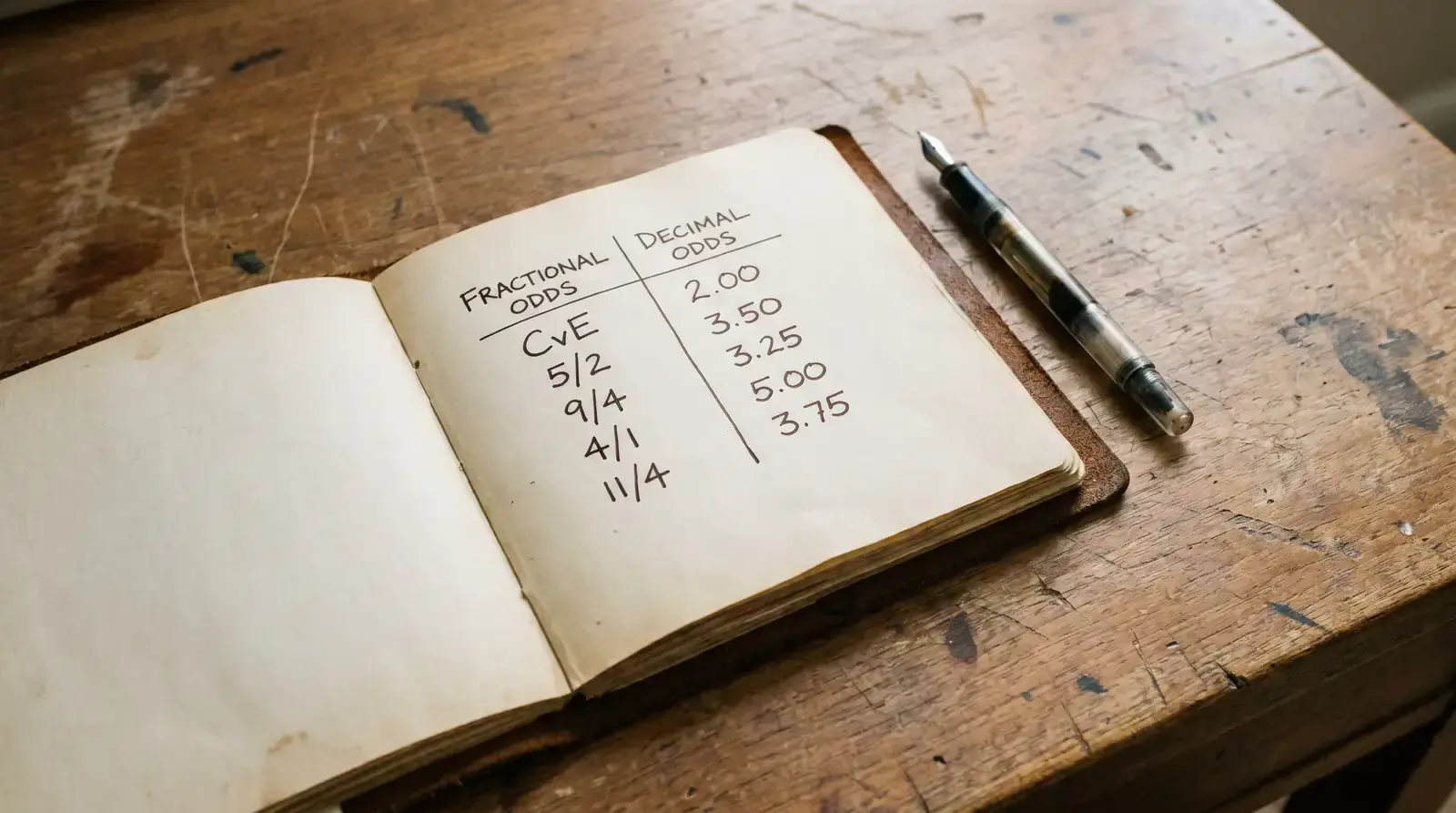
Why does this matter when you’re betting in fractional? Because cross-checking on an exchange or a non-UK site keeps you honest. If a sportsbook offers 11/4 on Top Bowler and the exchange is showing 4.10 on the same player, the sportsbook is the better deal – 11/4 converts to 3.75 decimal, so you lose 0.35 of price by going fractional with that operator. Conversely, the exchange might show 3.40 and the book 7/2 (which is 4.50). Now the exchange has shaved you a third of a unit of value.
The everyday rough conversions worth memorising:
Evens = 2.00. 6/4 = 2.50. 2/1 = 3.00. 5/2 = 3.50. 3/1 = 4.00. 4/1 = 5.00. 5/1 = 6.00. Anything with a denominator of 1 just adds 1 to the numerator. That covers maybe seventy per cent of the prices you’ll see on a typical cricket page.
I keep a sticky note on my desk for the awkward ones – 11/8, 11/10, 13/8, 11/4. Not because I can’t do the maths but because at speed, during in-play, I want to glance and know.
How fractional odds shape each cricket market
Different markets pull different ranges of price, and the fractional format makes some of those ranges feel more dramatic than they are.
Match Winner in a Test is the cleanest case. England 6/4, Australia 4/6, Draw 9/4 is a typical Lord’s-in-summer line. The favourite is short of Evens, the underdog is around Evens, and the draw catches anyone who reads only the two binary outcomes. The point to internalise is that 6/4 and 4/6 are both close to a coin-flip after you allow for the draw – the prices look further apart than the probabilities are.

Top Run Scorer in an ODI stretches the page. Front-line batters sit between 7/2 and 5/1, middle-order around 9/1, lower-order at 33/1 or 40/1. Those big fractions can feel like value, but they’re a tax on rarity rather than a gift. A number eight who comes in with twenty overs left and a wicket in hand is priced at 50/1 because he might not bat at all, not because the bookmaker is being generous.
Method of Dismissal is where I see new bettors get hurt by fractions. Caught sits at something like 8/13. LBW at 9/4. Bowled at 7/2. Run Out at 7/1. Stumped at 16/1. The very short Caught price masks the fact that this market has high operator margin baked in – across all six methods, the implied probabilities can total 115 or 120 per cent, with the overround spread across the long-tail dismissals. Fractional odds hide that overround better than decimal does. A 16/1 Stumped looks juicy until you realise the same site is paying 18/1 on the exchange, which means roughly two percentage points have been priced out of you on every method dismissal slip.

Session Bets, Innings Runs and Over Markets in T20 come at you in tight ranges – 5/6 vs 5/6 on most binary over lines, with the price shifting half a tick after every boundary. In-play fractional updates feel jagged in a way decimal doesn’t, because the fraction has to round to a denominator the page can render cleanly. You’ll watch a price tick from 10/11 to 5/6 to 4/5 to 8/11 and back, where decimal would have shown 1.91, 1.83, 1.80, 1.73. Same movement, different visual language.
For a deeper look at every line you’ll meet on a UK cricket page, I’ve covered the full set in the format-by-format walkthrough of cricket betting markets. The market-level detail there assumes you can read the prices – which, by the end of this piece, you will.
