
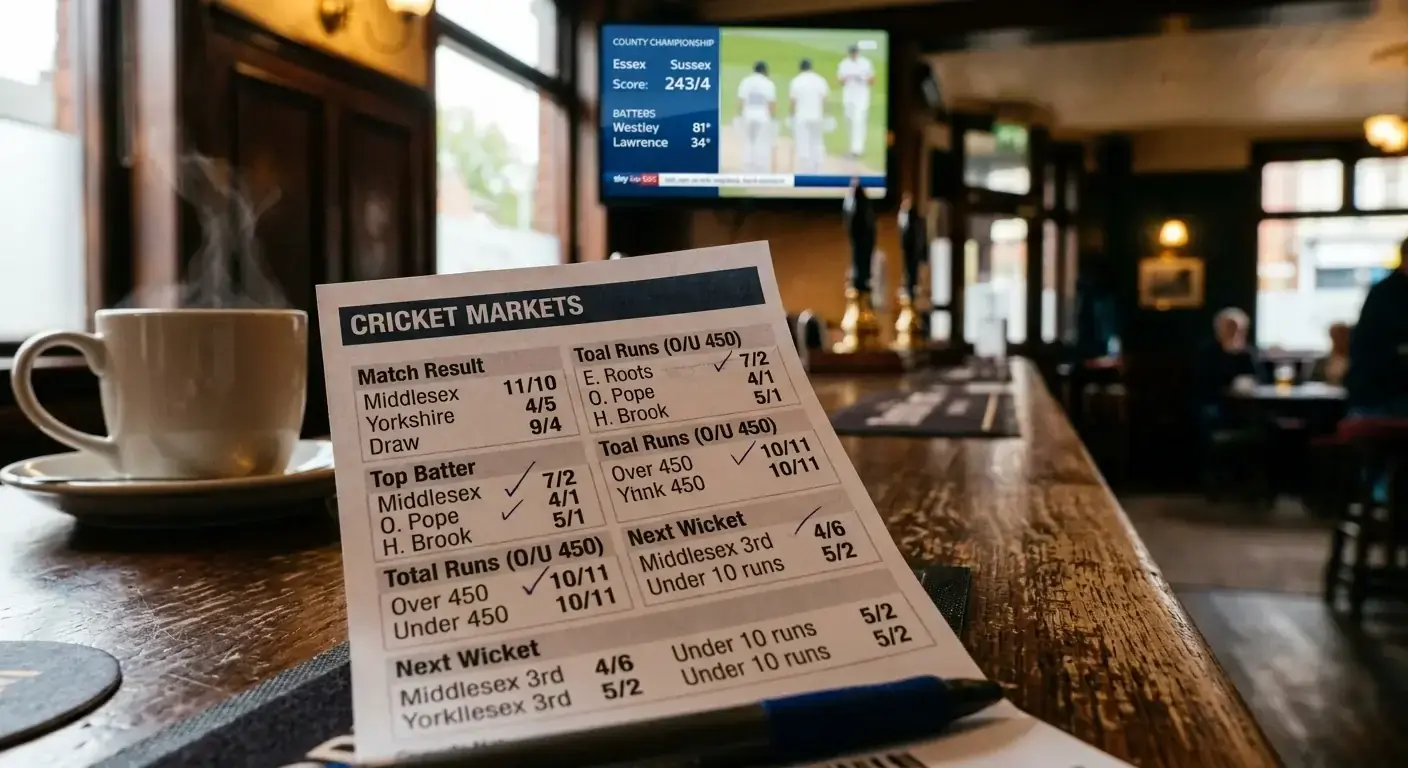

Match result, tie no bet, and the white-ball draw
The first thing to understand about match-result markets is that they look identical across formats and behave nothing like each other. A two-way price on a T20 game and a three-way price on a Test are different animals, settled by different rules, and traded by different kinds of punter.
In Twenty20 and one-day cricket, you usually get two outcomes: Team A or Team B. A tie, if it happens, normally returns stakes — though some operators settle on Super Over outcome, and a few quote a “tie” leg at long odds as a separate market. Always check the rules tab on whatever coupon you are reading. I once watched a friend cash a “winner” bet on a tied T20 because his operator settled on the Super Over and another mate of his lose the same bet at a competing site because that one voided. Same match, different rule books.
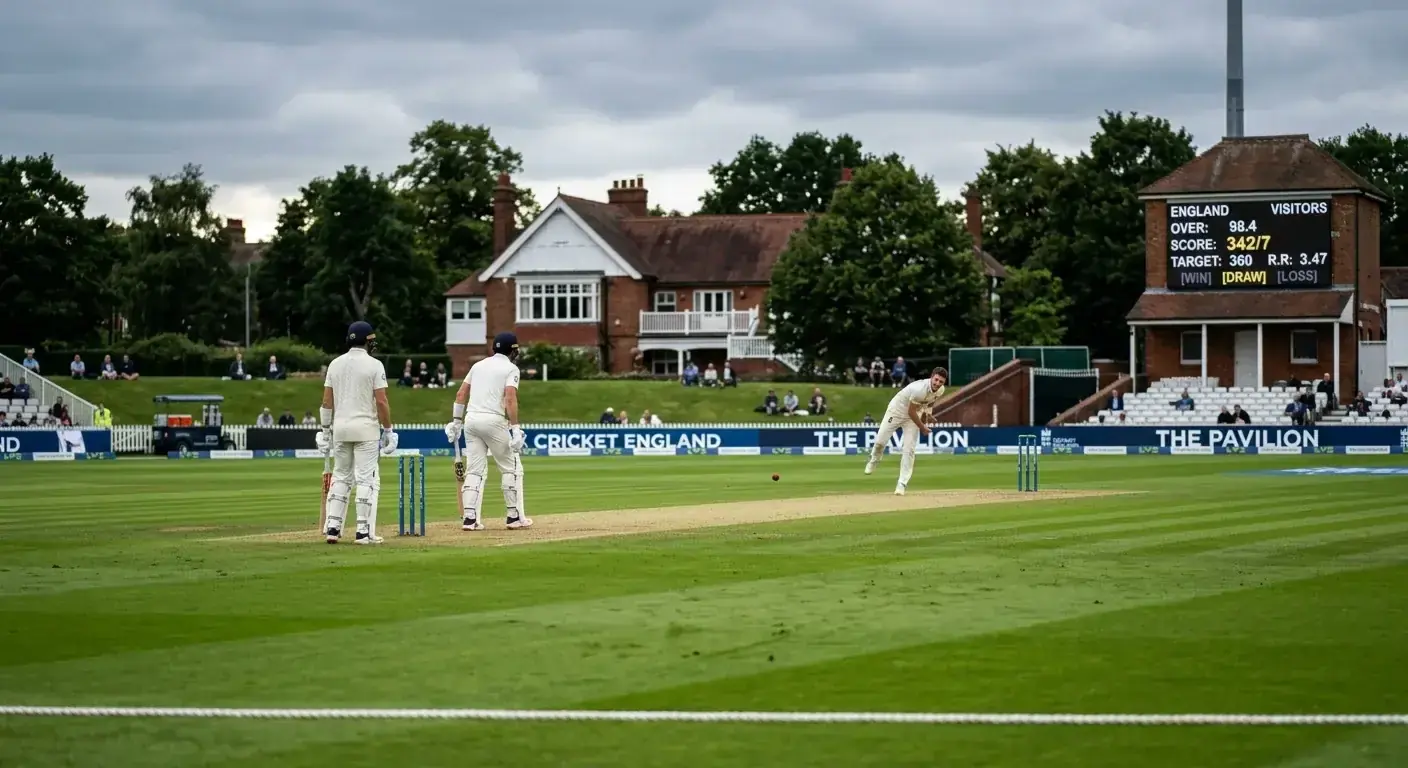
Test cricket gives you three outcomes — home win, away win, draw — and the draw is the most misunderstood price on the entire menu. A draw is not the same as a tie. In Test cricket, a draw means time ran out before either side could force a result. On flat pitches, in series where one side already leads, with a forecast of rain, that draw price can drift into genuine value. On a green seamer in April, it is a trap. The market is honest about this most of the time; what catches inexperienced bettors is that they read the draw price and assume it is rare. In English County Championship cricket — a four-day format — draws are anything but rare, and the price reflects that.
One more piece of plumbing worth knowing: most UK books offer a “tie no bet” or “draw no bet” version of match result, where a non-decision returns stakes and prices on the two sides shorten accordingly. The headline is simple — you pay a premium for that insurance, and the premium is rarely worth it on flat formats.
Top batter and top bowler: where the casual money piles in
I have a soft spot for top-batter and top-bowler markets, mostly because they are where the casual money goes and where the prices end up being shaped more by emotion than by maths. Eleven names on a card. One winner. The favourite is usually the player whose face you saw most on Sky last week.
The mechanics first. “Top batter” means top run scorer for one team in a specific innings — not the match, an innings. If England bat once and Australia bats twice, the England top batter is settled on the single innings; the Australian top batter, depending on operator wording, can be either innings combined or first innings only. This catches people out constantly. The “top run scorer” market, by contrast, is usually match-wide and covers every innings. Different markets, different settlement, sometimes overlapping prices on the same player.
YouGov data places 21% of UK cricket fans as past-12-month online bettors, close behind football at 23%, which tells you the cricket coupon attracts a real volume of fan-led money. That fan money concentrates in two places: the team they support and the player they recognise. Top-batter markets are where that concentration is most visible. The recognisable opener — your Joe Root, your David Warner — gets backed in regardless of conditions, and the price shortens accordingly.
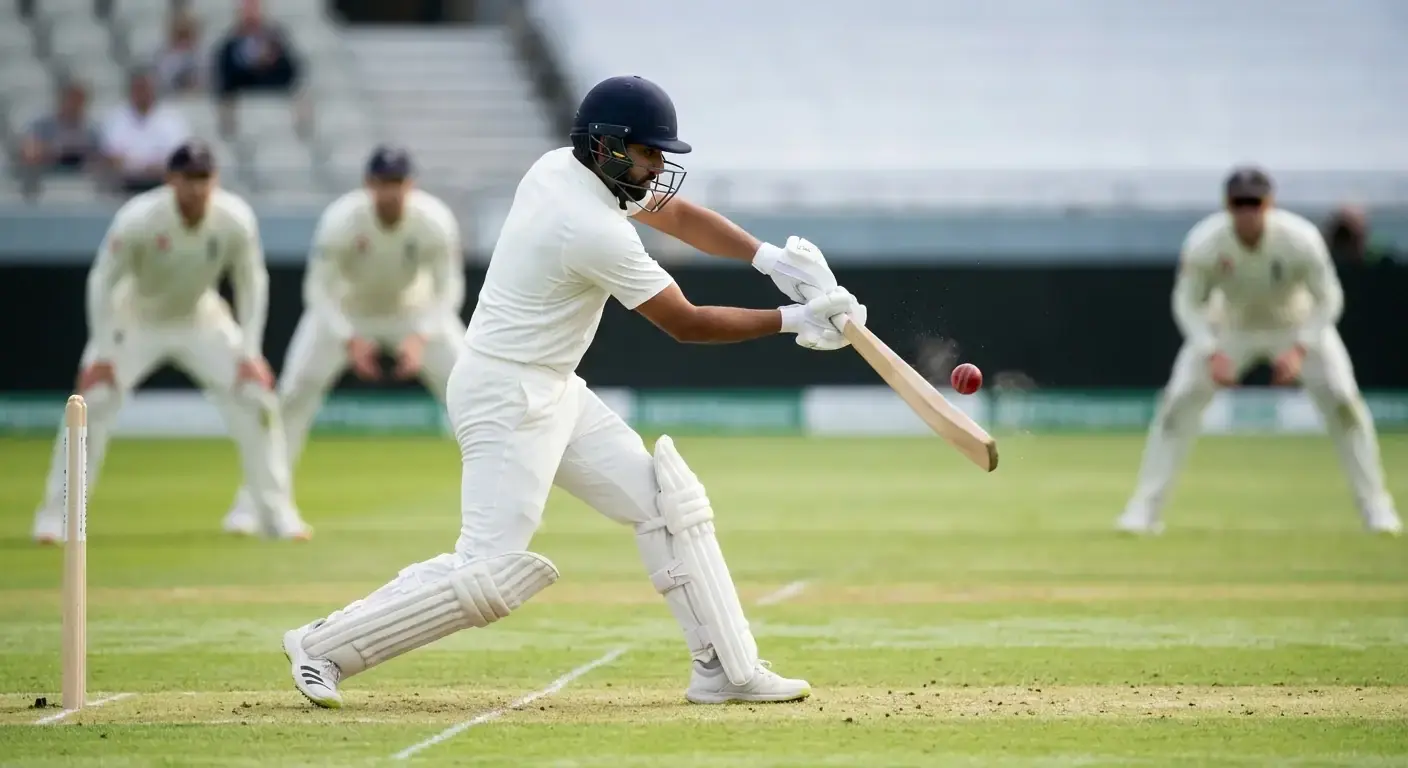
Where I look for value is in the middle order on slow pitches and the openers on green ones. The traditional read is that an opener gets the most balls and therefore the best chance, but that ignores how much top-order failure is built into modern cricket. On a seaming Headingley morning, openers face the toughest spell. The number four — who often comes in after lunch on a softer ball, against a tiring attack — is mispriced by the recognition bias I just described. Top-bowler markets work the same way in reverse. The strike bowler with the biggest reputation gets the spell that costs him wickets; the second-change seamer cleans up the tail at 6/1.
One genuine caveat. Top-batter and top-bowler are not deep markets at every UK site. On The Hundred, on County Championship cricket, on smaller women’s fixtures, you can find the same player priced 9/4 at one operator and 7/2 at another within an hour of the toss. The margin spread is wider than on football. Shop the line.
Total runs, handicaps, and why the line is the price
If match result is the headline market, totals — runs, wickets, sixes, fours, boundaries — are the engine room. They are where I do most of my pre-match work, and they are where format genuinely matters.
Total runs comes in two flavours. Match total covers every innings. Innings total covers one. On a T20, those are similar conversations: 320 runs across two twenty-over innings, give or take. On a Test, they are radically different. A 1100-run match line and a 350-run first-innings line are different bets with different settlement risk. The first-innings line is reliably the more efficient market because conditions are visible and the line moves with the toss; the match line absorbs five days of weather, declarations and momentum, which makes it both noisier and, occasionally, more rewarding.
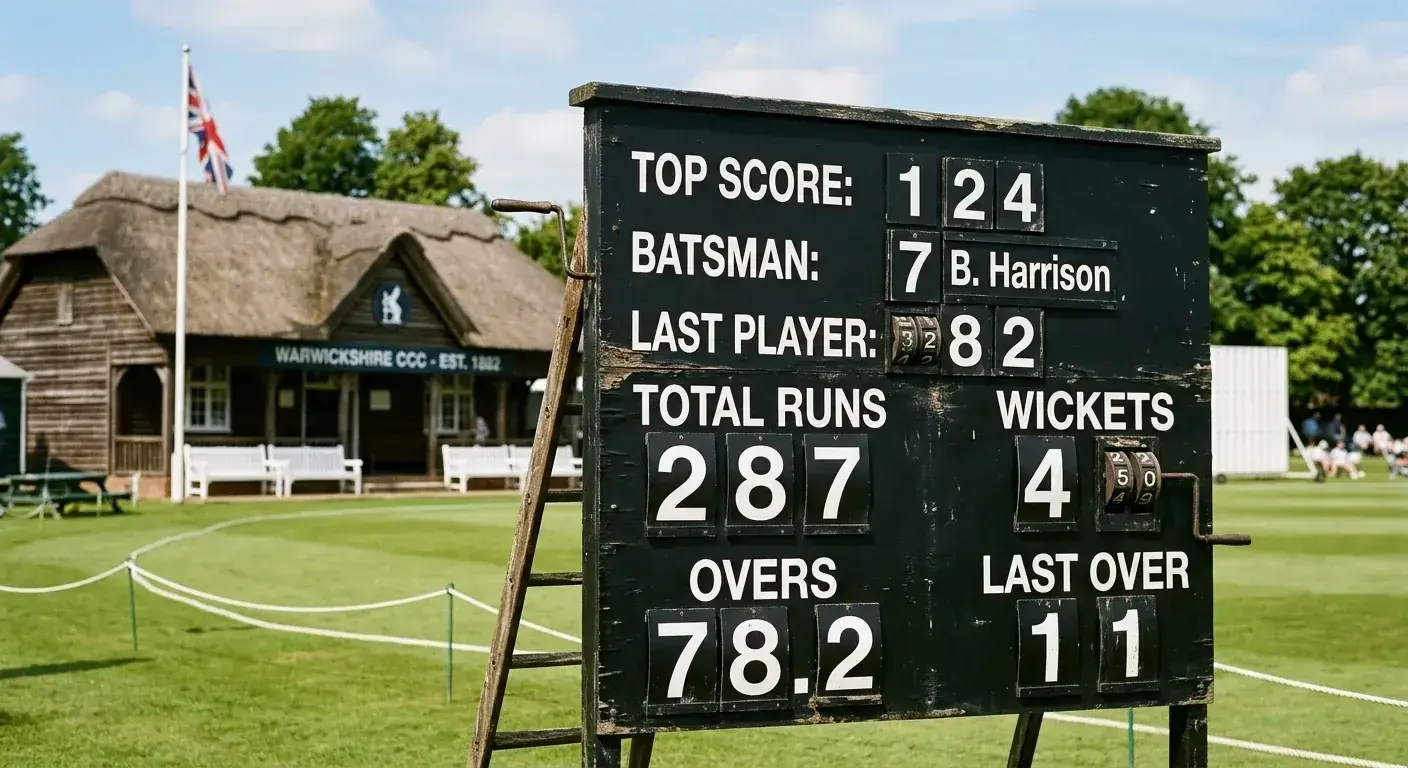
Handicap markets in cricket take some getting used to if you come from football. A run-line handicap of −22.5 on Team A means Team A must win by 23 or more runs; if they are chasing, the handicap is applied to the deficit. A wickets handicap reverses the geometry — Team A −2.5 wickets means they must win and the losing side must be all out, with fewer than seven wickets needed to bowl them through. Operators differ on how they handle abandoned matches under handicaps; some void, some settle on Duckworth–Lewis par, some refund only the handicap leg of an accumulator. Read the rules.
The line, not the price, is where the bookmaker shows you what they think. A first-innings runs line of 280 with -110 either side tells you the model expects a chase. A line of 280 with -130 on the over tells you the model expects a chase and the punters have been hammering the under. That second case is where I look hardest.
Method of dismissal and why the margin sits high
Method of dismissal is the market I get asked about most. Bowled, caught, LBW, run out, stumped, hit wicket. Eleven players walking out to bat, six ways each can be dismissed, plus the chance they finish not out. The combinatorics are why the margin is high and the answers are interesting.
The honest version of this market is “next dismissal,” where you pick how the next wicket falls. On a green-seamer Test morning, bowled and LBW combined account for an outsized share of dismissals — sometimes 55% by my count of recent Test data — yet the combined price often pays less than that implied probability suggests. That gap is the margin, and on method-of-dismissal it can sit north of 12% versus 5–6% on the match-result line. You are paying for the operator’s uncertainty.
Where the market becomes interesting is on a flat, sub-continental pitch, late in the innings. Caught dismissals dominate when batters are taking risks; run-outs cluster in death overs. If you can read the game-state on Sky and price the next ten balls in your head, method-of-dismissal lets you put that read on paper. Just remember the margin is doing real work against you. Smaller stakes, sharper picks.

One operator-specific note worth raising: some UK sites offer a “first wicket method” market, settled at the fall of the first wicket of either innings. This is one of the lower-margin variants of method-of-dismissal because the first wicket is statistically the most predictable on conditions data. If you must play this market type, the first-wicket version is where I would start.
Session bets and the rhythm of over markets
Sessions are where Test cricket becomes a casino in slow motion. A session is the period between one break and the next — morning to lunch, lunch to tea, tea to stumps — and almost every UK book quotes runs, wickets, top batter and total fours for the session as a standalone market.
The mechanics matter and they vary. If a session ends early — bad light, rain, an innings finishing mid-session — the standard rule is settlement at the actual end-of-session score, but on a few operators the runs market voids if fewer than a set number of overs were bowled. I have seen the same bet pay at one site and refund at another because of this. The threshold is usually 25 overs for a Test session and 8 overs for a T20 innings session. Check it before you stake.
Over markets — total runs in the next over, wickets in the next over, whether the next ball is a six — are the most aggressively traded in-play products on the UK coupon, and they account for a meaningful slice of the 67.5% share that online platforms hold in global sports betting. The volume reflects how the format has shifted: T20 and The Hundred are designed around short bursts of decision, and the markets have followed. I write about the live mechanics in detail in my guide to in-play cricket betting in the UK, but the short version is that these markets reward attention more than they reward analysis. Eye on the screen, finger on the cash-out button.
The trap on session bets is over-confidence. A morning session at Edgbaston in May is not the same product as an afternoon session at the Wankhede in April. Sessions cluster by venue, conditions and ball age, and the operators know it. The lines are usually sharp. Where I find value is on second-day-onwards Test sessions where the new ball is more than fifty overs away — the runs lines tend to be set a touch high, anticipating acceleration that often does not arrive.
Player milestones: hundreds, five-fors, hat-tricks
Milestone markets are the long-shot end of the cricket coupon, and they are designed for romance, not value. Will Player X score a century? Will Player Y take a five-wicket haul? Hat-tricks. Maiden overs. King pairs. The prices stretch from 5/2 on a Kohli century in his prime to 250/1 on a hat-trick.
The pricing on the headline milestones is generally tight. Bookmakers know the probability of a top-order batter scoring a century in a given Test innings is well above the implied 15%-or-so price that sometimes appears. The market that I think gets mispriced more often is the “fifty plus” line for middle-order players in T20s. Middle-order T20 batters get fewer balls but they get them late, when fields are out and the ball is soft. A 45/1 fifty on a number five who consistently gets twenty deliveries at the back end is, by my reading, closer to 30/1 in true probability terms.

Settlement notes worth memorising. A century market on a player who retires hurt before reaching it is typically voided — but only if the player did not have the chance to resume. If they could have come back and chose not to, some operators settle as “lose.” The hat-trick market is settled across an innings, not a single over, on most UK sites, which is more generous than people assume.
Exchange markets versus fixed-odds books
Cricket is one of the formats where the betting exchange genuinely changes how you can play, and any walkthrough that skips exchanges is incomplete. A traditional sportsbook quotes you a price and you back it. An exchange lets you back at one price and lay — accept someone else’s back bet — at another, with commission charged on net winnings rather than baked into the line.
For UK cricket specifically, the exchange shines on long-form. Test matches and First-class cricket move slowly enough that liquidity has time to settle, and the difference between back and lay prices — the spread — can narrow to a level that fixed-odds books cannot match. On a T20, the exchange spread is wider because the match is over before liquidity matures. The pragmatic read is: exchange for Tests and high-profile ODIs, sportsbook for T20 and franchise leagues.
Andrew Rhodes, Chief Executive of the UK Gambling Commission, said in 2025 that he could not understand why anyone in the licensed industry would want to be in business with a company supporting illegal competition — a comment aimed at white-label and crypto-rails arrangements that has implications for which exchanges remain available to UK punters. The licensed exchange market is small, and the commission rates have crept up over the past five years. For this walkthrough, the key takeaway is that the exchange is where the sharpest cricket punters operate, and the prices reflect that.
How margins shape the prices you see
Margin — sometimes called overround, juice, vig or the bookmaker’s edge — is the silent line item on every cricket bet you place. If a two-way market is priced 10/11 on either side, the margin is roughly 4.5%. If it is 4/6 either way, the margin is closer to 20%. That gap is where the operator pays its costs, takes its profit and, on cricket, where the punter loses most of their long-run edge.
The remote sector in Great Britain reported £7.8 billion in gross gambling yield for the year to March 2025, a 13.1% rise. That GGY is the aggregate of all those margins across every market, every operator, every sport. Cricket sits somewhere in the middle of the sport-by-sport margin spectrum — wider than football match-odds, narrower than darts player props.

The margins on cricket vary hugely by market type. Here is the rough hierarchy I work with, sharpest to most expensive, on a typical UK book:
- Match result (two-way T20/ODI): 3–5%
- Test match result (three-way): 5–7%
- Run-line handicap: 4–6%
- First innings total runs: 4–6%
- Top batter (each innings): 9–12%
- Method of dismissal: 12–18%
- Player milestones (century, five-for): 15–25%
- Long-shot specials (hat-trick, king pair): 25%+
The lesson buried in that hierarchy is brutal but simple: the more exotic the market, the more you are paying for the operator’s uncertainty. A 5% margin compounds into bankroll death across a hundred bets; a 20% margin is essentially a slow donation. Sharp cricket bettors play the top of that list and treat the bottom as entertainment.
Format-specific market depth: where to look in each game
Different cricket formats are built around different decisions, and the market depth on UK sites reflects that. Knowing which markets are deep in which format is half the work.
Test cricket is where the slow-burn markets are best priced. Match result with the three-way draw, session-by-session totals, top run scorer across the series, total fifties, total centuries, even fall-of-wicket markets. UK fixed-odds books cover Test cricket more deeply than any other format because the audience skews older and wealthier — over 40% of UK cricket fans are aged 65 or older, with Test cricket the format that age cohort most reliably watches. That demographic skew shows up in the menu.
T20 internationals and the IPL get the deepest in-play menus on UK sites. Next-over runs, ball-by-ball outcomes, fall-of-wicket overs, batter-versus-bowler matchups, even player-of-the-match prediction markets that update over by over. This is the format where operators invest in pricing infrastructure because volume is densest.
The Hundred sits in an interesting middle position. The format is newer, the audience is younger — 31% of The Hundred’s fanbase is aged 18 to 44, against 24% across UK cricket fans generally — and the markets reflect a more app-driven user. You see more “next 10 balls” and fewer multi-innings totals; more player milestones, fewer session bets. The format and the menu have evolved together.
County Championship cricket is the thinnest market depth on a UK coupon. Match result, total runs, top run scorer at the bigger fixtures, and that is roughly that. Some operators do not price the Championship at all between rounds. If you want exotic markets on Surrey versus Lancashire, the exchange is your only realistic option. The width of the spread will reward your patience or punish your impatience.
One last format note: women’s domestic and franchise cricket — the Women’s Hundred, the WBBL, the WPL, the women’s T20 internationals — has grown faster on the market-depth side than any other category over the past three years. The match-result, top-batter and top-bowler lines on women’s fixtures are sharper than they were in 2023, partly because attendance has caught up — the Women’s Hundred set the global record for a women’s cricket competition with 349,401 fans in 2025. Markets follow audiences, eventually.
