


The free bet I left to expire and the one I used properly
An English summer, two free bets, two completely different outcomes. The first was a £20 free bet credited to my account during a Test match I wasn’t watching closely. The notification went into the same folder as a hundred other promotional emails. By the time I checked the account during the next Ashes Test, the credit had expired and been removed. £20 of stakeless betting capacity that I’d done nothing with. The second came a few months later – a £15 free bet during the T20 Blast – and I used it on an outright knockout selection at 9.50, paid out as a winner, and netted £127.50 in actual cash returns. Same operator, same kind of credit, two completely different uses. The difference wasn’t luck. It was whether I’d actually engaged with the credit and used it on a selection that justified the stakeless structure.
This piece is about how free bet credits actually work at UK cricket betting sites – the mechanics that make them different from cash bets, the rules that govern their use, and the strategic considerations that separate free bets used well from credits left on the table.
What a free bet actually does
A free bet is a non-cash betting credit that the operator places in your account. You can use the credit to back a selection at any market that the operator permits for free bet use. If the selection wins, the cash winnings (excluding the stake) credit to your account as withdrawable cash. If the selection loses, you’ve lost nothing because the stake was the credit, not your own money. This is the structural feature that makes free bets distinct from cash betting – the asymmetry between potential winnings (real money) and potential losses (just the credit) is what gives the bet its positive expected value when used appropriately.

The headline mechanics are simple. A £10 free bet at 2.00 settles for £10 in actual cash winnings if the bet lands. A £10 free bet at 5.00 settles for £40 in cash winnings (the £50 total return minus the £10 stake which doesn’t return). A £10 free bet at 10.00 settles for £90 in cash winnings. The longer the odds, the more cash the free bet extracts when it lands, because the stake makes up a smaller proportion of the total return.
This is why the optimal use of a free bet is on longer-odds selections rather than short favourites. A free bet at 1.5 settles for £5 cash if the favourite lands and zero if it doesn’t. The expected value of that use is around £3 to £3.50, depending on the punter’s edge versus market margin. A free bet at 5.00 on a selection the punter genuinely thinks is value extracts much more from the credit structure because the stake-less feature has more to work with at longer odds.
Where the free bet typically comes from
UK cricket betting sites credit free bets in several contexts. Welcome bonuses for new customers often include free bet credits (typically £10 to £30) after a qualifying first deposit and bet. Promotional offers around major events (Ashes Tests, IPL playoffs, ICC finals) may credit free bets to existing customers as activity incentives. Refund promotions on losing bets – particularly accumulator insurance – typically refund the lost stake as a free bet credit rather than cash. Loyalty programmes accrue free bet credits over time as a reward for sustained activity.

The source affects the terms attached. Welcome bonus free bets usually have substantial restrictions on minimum odds, expiry windows, and eligible markets. Loyalty credits often have lighter restrictions. Refund credits often need to be used within tight windows (3 to 7 days). The 2025 statutory levy on gambling operators, in force from 6 April 2025 at rates between 0.1% and 1.1% of gross gambling yield, has shifted operator economics. Gambling Commission CEO Andrew Rhodes has spoken about the broader reform agenda being the largest programme since the 2005 Act, and the terms attached to free bets are presented more clearly and subject to closer regulatory scrutiny.
Minimum odds and where they bite
Free bets almost always come with minimum odds requirements. The most common threshold is 1.5 decimal odds (equivalent to 1/2 fractional). Some operators set the minimum higher at 1.7 or 2.0. The minimum is designed to prevent punters from using free bets on extreme favourites where the stake-less structure provides minimal value extraction.

The strategic implication is that free bets work well on outright tournament markets, on competitive bilateral matches, on player-prop markets where prices are typically longer, and on bet builder structures that combine multiple selections into a single longer-odds position. They work poorly on heavy favourites in established mismatches and on cash-out scenarios where the price has already shortened from the original.
Eligible markets and exclusions
The markets eligible for free bet use vary by operator and by the specific promotion. Standard match-result markets and outright tournament markets are usually eligible. Player prop markets are often eligible. In-play markets vary – some operators exclude all in-play from free bet eligibility, others allow it. Specific exotic markets (method of dismissal, fall of first wicket, first innings score brackets) may or may not be eligible depending on the operator’s risk appetite for stakeless betting in those segments.
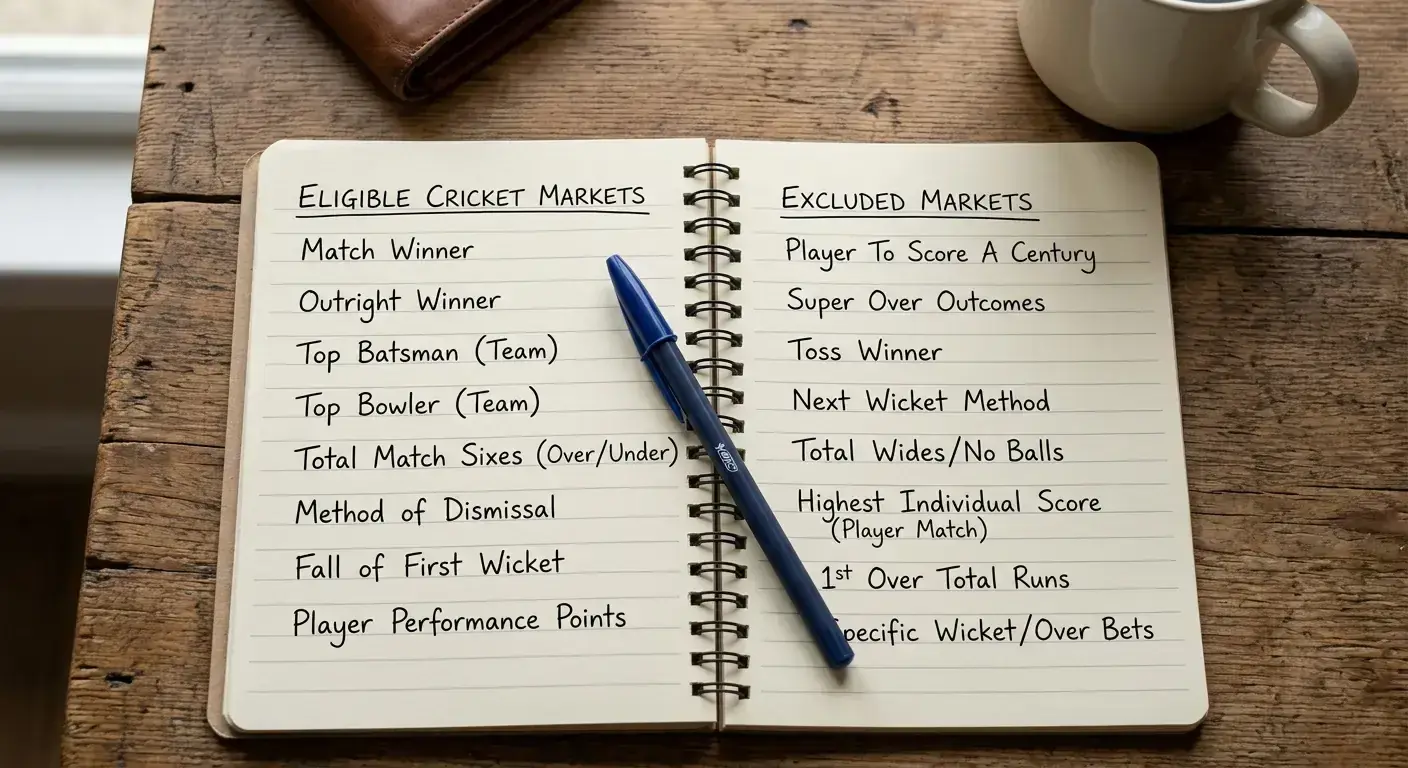
The exclusions matter because they shape where the value of the credit can be extracted. A free bet that’s only usable on match-result markets in major fixtures is more constrained than one usable across the operator’s full cricket offering. The credit’s effective value depends on whether the punter can deploy it on selections that align with their actual reading of the cricket calendar, not just on whether the credit exists.
I check the eligibility rules before using any significant free bet credit. If the credit excludes my preferred markets, the value of the credit is lower than the headline suggests, and the deployment strategy needs to account for the constrained set of available bets. Sometimes the right answer is to use the credit on a more conservative selection within the eligible markets rather than chasing optimal use into restricted territory.
Expiry windows and the value of immediacy
Free bet credits expire. The typical window is 7 days from credit, though some welcome bonuses extend to 30 days and some refund credits compress to 24-72 hours. Once the window passes, the credit is removed from the account regardless of whether the punter saw the notification.

The pattern with expired credits is consistent. Punters get credits, intend to use them, get distracted, and the window passes. The £20 free bet that opened this article was a classic case. The fix is structural. When a free bet credits to the account, I now place a calendar reminder for two days before expiry and another for the morning of expiry. The conscious decision to let the credit expire is rare – when it’s in front of me, I find a sensible use.
The strategic deployment question
The framework I use for deploying free bets is to ask three questions. The first is whether the credit can be used on a selection I’d genuinely be willing to bet with cash. The second is whether the available odds are long enough to justify the stakeless structure. Free bets work best at 3.00 or longer, where the stake makes up a third or less of the total return. The third is whether the expiry window aligns with cricket fixtures I’m following.

The selections I’ve extracted most value from are outright tournament markets at meaningful prices (8 to 15 to 1 range on competitive tournament fields), player props at long odds with genuine reads, and competitive bet builders combining multiple selections from the same match. The selections I’ve extracted least value from are short favourites, in-play selections placed reactively, and refund credits used on markets I hadn’t been following. Credits used on selections that fit my actual cricket reading produce real value; credits deployed reactively produce poor returns.
Combining free bets with regular betting
Free bets don’t have to be used in isolation. A common strategy is to use a free bet alongside a cash bet on a related market, structuring the position so the free bet adds to expected value on a position the punter would have taken anyway. If I have a strong read on a Test match outright and a £20 free bet to deploy, using the free bet on the outright market complements rather than replaces the cash bet I’d have placed.
The risk is that the convenience of having a free bet to deploy can prompt a larger combined position than the underlying read justifies. Treating the free bet as a separate decision from the cash bet, even when both are on the same market, prevents the position size from drifting. The two bets are independent positions, and the margin paid is the standard margin on the cash bet plus zero margin on the free bet, unlike multi-leg accumulators where margins compound.
The risk-free bet variant
Some UK operators offer “risk-free bets” or “money back if losing” promotions on specific qualifying bets. The structure is that the punter places a cash bet, and if the bet loses, the stake is refunded as a free bet credit. The promotion often applies to first qualifying bets at new accounts or to specific match offers around major events.
The mathematics are favourable but more modest than the headline suggests. A £50 risk-free bet that loses produces a £50 free bet credit, but the credit is worth around £20 to £30 in expected value depending on how the punter uses it. The combined expected value is higher than a £50 cash bet, but not by the full £50 that the “risk-free” branding suggests. The selections that work well are competitive matches at moderate odds where the punter has a genuine read.
The connection to the broader bonus framework
Free bets sit within the broader UK bonus framework alongside deposit-match bonuses, odds boosts, and refund promotions. The structural difference is that free bets are credit-based – the bonus is the bet itself, not money added to the account that requires wagering to release. This makes free bets simpler to evaluate because there’s no rollover requirement, no minimum wagering, and no eligibility filter beyond the specific bet placement.
The Gambling Commission’s quarterly statistics for the year to March 2025 showed the remote sector generating £7.8bn in gross gambling yield, up 13.1% year on year. Free bet promotions are part of how operators compete for activity, and the structure that makes free bets useful for punters – stakeless betting with cash returns – is also what makes them costly for operators, which is why the terms attached have tightened over time.
How free bets fit my cricket betting
The role of free bets in my cricket betting has settled into a routine pattern. Welcome bonuses on new accounts get used deliberately within the expiry window on outright markets that align with my reading of the upcoming tournament. Refund credits from acca insurance get treated as planned-for value within the cost of large multi-leg betting. Promotional credits during major events get evaluated against my existing positions and either used to complement them or set aside if they don’t fit the planned activity.
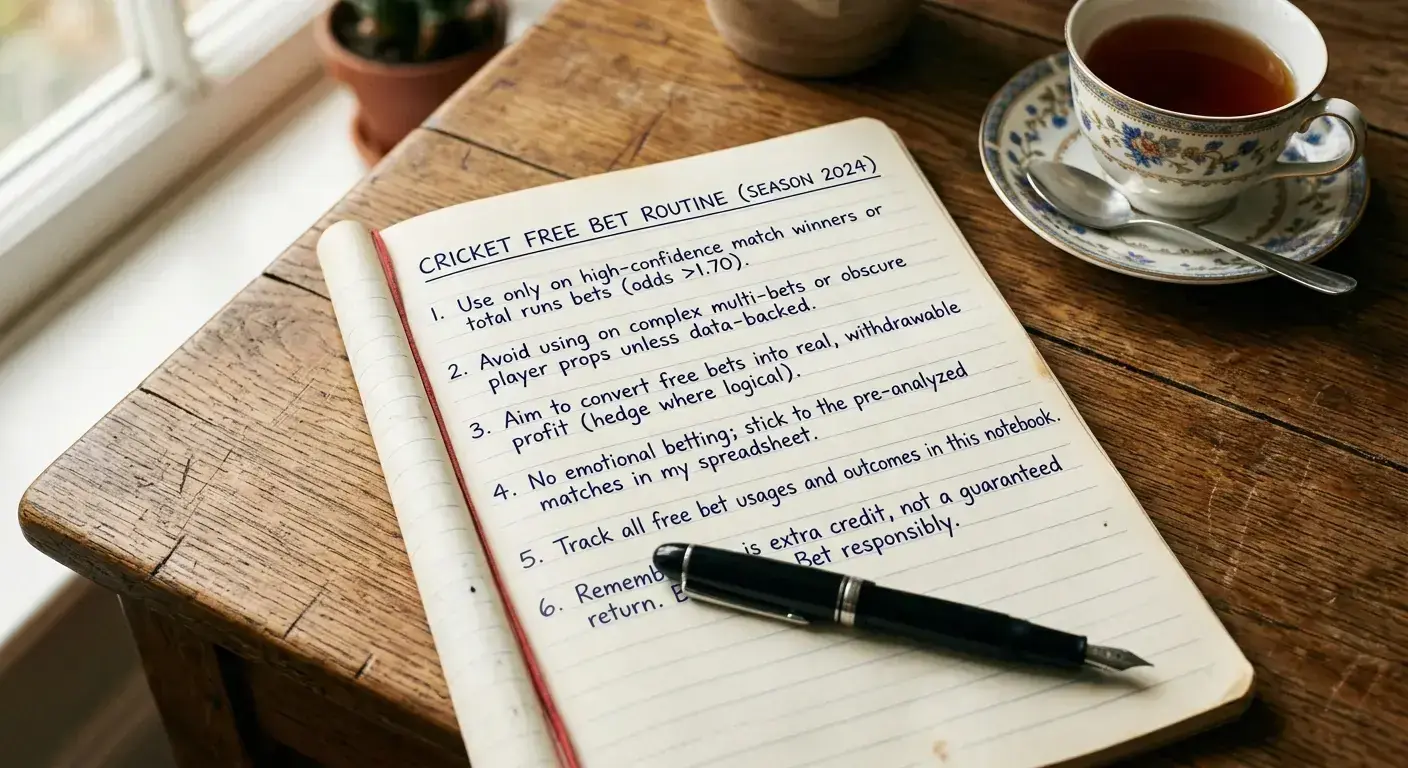
The principle that’s emerged from years of using free bet credits is that the value of a free bet is in the deployment, not in the existence. Credits that sit in accounts unused are worth nothing. Credits used on selections that don’t align with the punter’s actual reading produce poor returns. Credits deployed deliberately on selections that justify the stakeless structure produce real value. The £127.50 from the T20 Blast outright was a credit used well. The £20 that expired during the Ashes was a credit ignored. The difference between the two outcomes was attention, not luck, and the attention is the variable the punter controls.
