


The market that taught me how prices actually work
I spent years betting on sportsbooks before I really understood what a price was. The exchange taught me. Watching back and lay prices move in real time, with the volume bar showing exactly how much money sat at each tick, finally made the abstract idea of probability feel concrete. A 2.00 lay isn’t just “Evens”; it’s a number with depth behind it, and you can see how deep before you click.
This is the read for any UK punter who’s been betting on sportsbooks and is starting to wonder whether the exchange model is actually built for them.
Exchange versus traditional sportsbook
A sportsbook is the bookmaker setting prices and taking your money. The bookmaker wins when the cumulative price across both sides of a market exceeds 100% – that excess is the overround, and it’s how the sportsbook pays the bills.
An exchange is a marketplace. Other bettors set the prices by offering bets, and you accept them. The exchange takes a commission on net winnings rather than building margin into the prices themselves. That structural difference produces three concrete consequences.
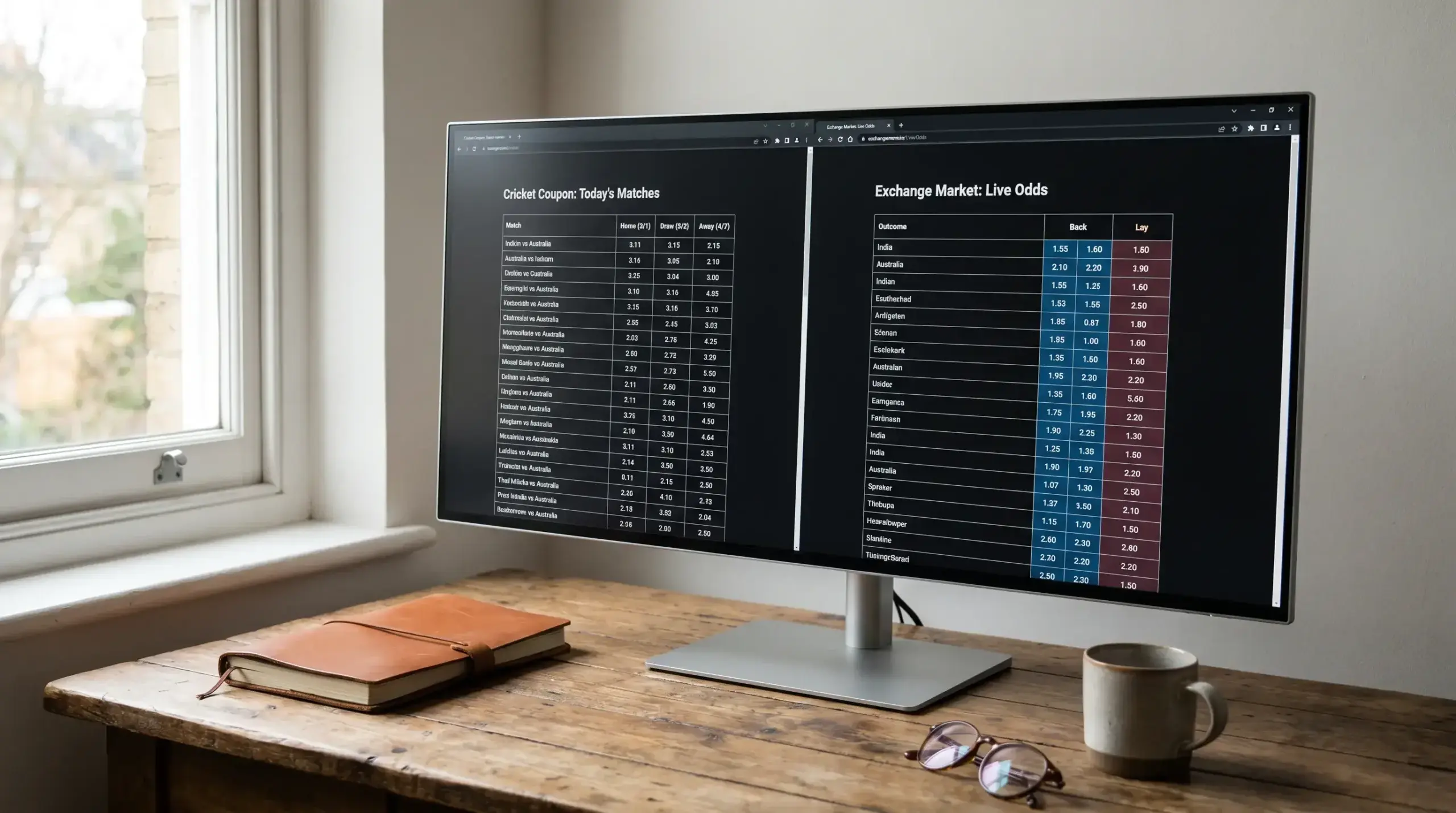
First, the prices on the exchange are tighter. Match Winner spreads on a typical cricket fixture are 1-2% on the exchange versus 4-8% on a sportsbook. Over the course of a season, that price difference compounds – a punter who consistently gets exchange prices instead of sportsbook prices saves 3-5% of turnover.
Second, you can lay as well as back. A back bet is the standard “I think this team will win” position. A lay bet is “I think this team will not win” – you’re acting as the bookmaker for someone else’s back. Cricket lay markets are how professional punters express specific negative views: “this batter won’t reach 50”, “this team won’t successfully chase”.
Third, prices change live and you can see the order book. The depth at each price tick is visible. A Match Winner price of 2.10 with £50,000 of back money waiting at that tick tells you something very different from the same 2.10 with £500 of back money. Order book depth is the most underrated piece of information in modern cricket betting.
The current UK remote casino, betting and bingo sector turned over £7.8 billion in gross gambling yield in the year to March 2025, a 13.1% increase year-on-year. Exchange volume is a meaningful share of that total – not a dominant share, but a structurally important one for the price discovery the whole UK cricket market depends on.
How back and lay mechanics actually work
A back bet on the exchange works exactly like a sportsbook bet. You pick a team, accept the price, stake your money, and if the team wins you get your stake plus the profit. £20 back at 2.50 returns £50 – £30 profit plus £20 stake.
A lay bet is the mirror image, and it confuses new exchange users until they’ve placed a few. You pick a team, accept the price, and now you’re betting that the team will not win. The stake you risk isn’t the headline number – it’s your liability, which is the amount you’d pay out if the team you laid does win.
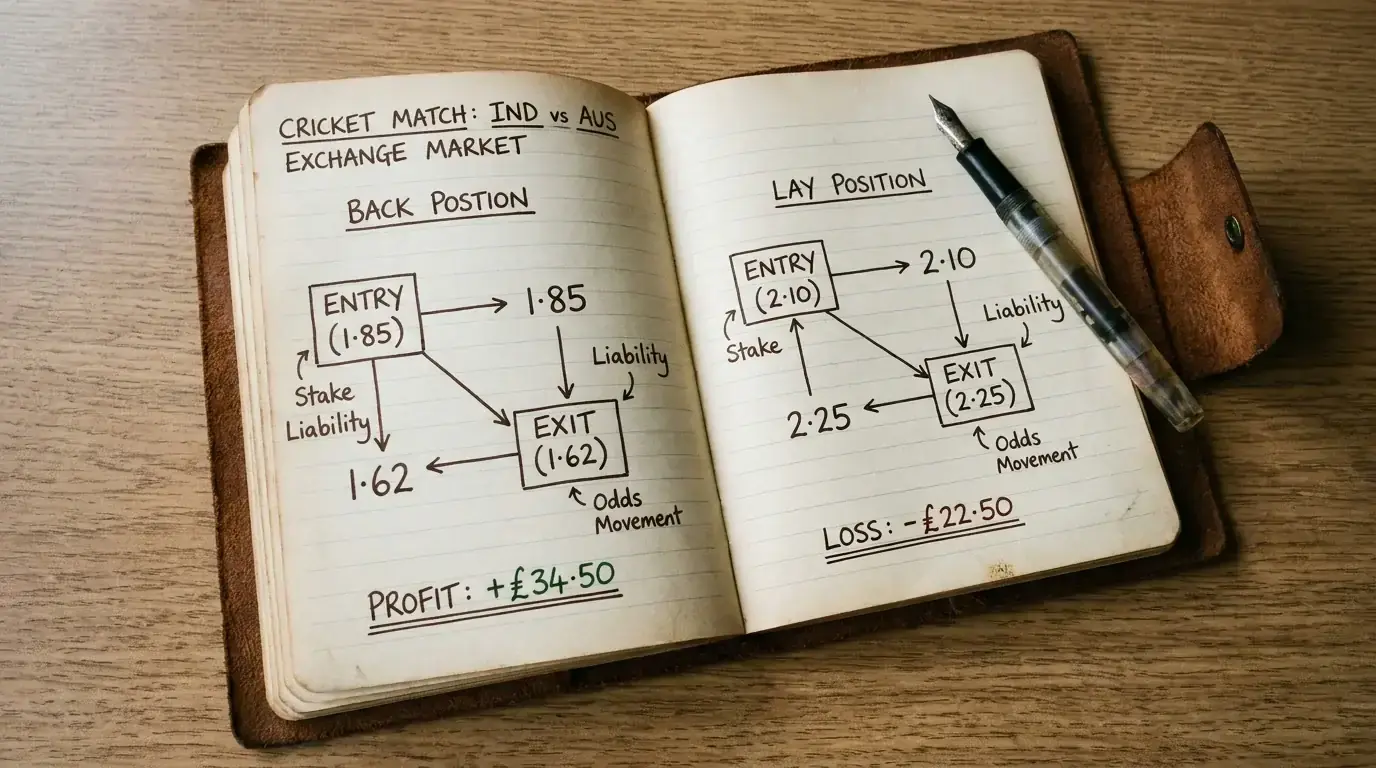
Worked example. You lay India to win the match at 2.00 for a stake of £20. If India lose, you keep the £20 – that’s your profit. If India win, you owe the backer £20 (the implied profit on a £20 back at 2.00). Your liability and your potential profit are equal at 2.00 because the price is Evens.
The liability ratio changes with the price. Lay at 3.00 for £20 stake and your liability is £40 if the team wins. Lay at 5.00 for £20 stake and your liability is £80. The longer the price, the bigger the liability for the same nominal stake. That’s why exchange lay positions look more dangerous than sportsbook bets – the maximum loss is bigger than the stake.
The flip side: you can lay anything at any price the market offers, which lets you express views the sportsbook doesn’t price. You can lay an underdog at 8.00 for a £5 stake, risking £35 in exchange for £5 profit if the favourite wins. That’s a structurally different bet from anything on a sportsbook coupon. For the underlying market types that feed into exchange action, the full walkthrough of cricket betting markets shows which ones translate cleanly to back/lay and which lose value when forced into exchange shape.
Liquidity and how it varies by cricket format
Exchange liquidity in cricket follows the broadcast audience. IPL games carry the deepest liquidity of the cricket year – Match Winner markets typically have £200,000-500,000 matched per fixture, with hundreds of thousands more sitting unmatched at adjacent ticks. Big international cricket – ICC tournaments, the Ashes, England-India ODIs – sits in a similar range.
The Hundred is the surprise story of recent years. Liquidity on Hundred fixtures has grown dramatically since the 2024 season and now competes with mid-tier IPL games. A typical Hundred Match Winner sees £50,000-150,000 matched, which is enough depth for any non-professional cricket bettor to operate freely.
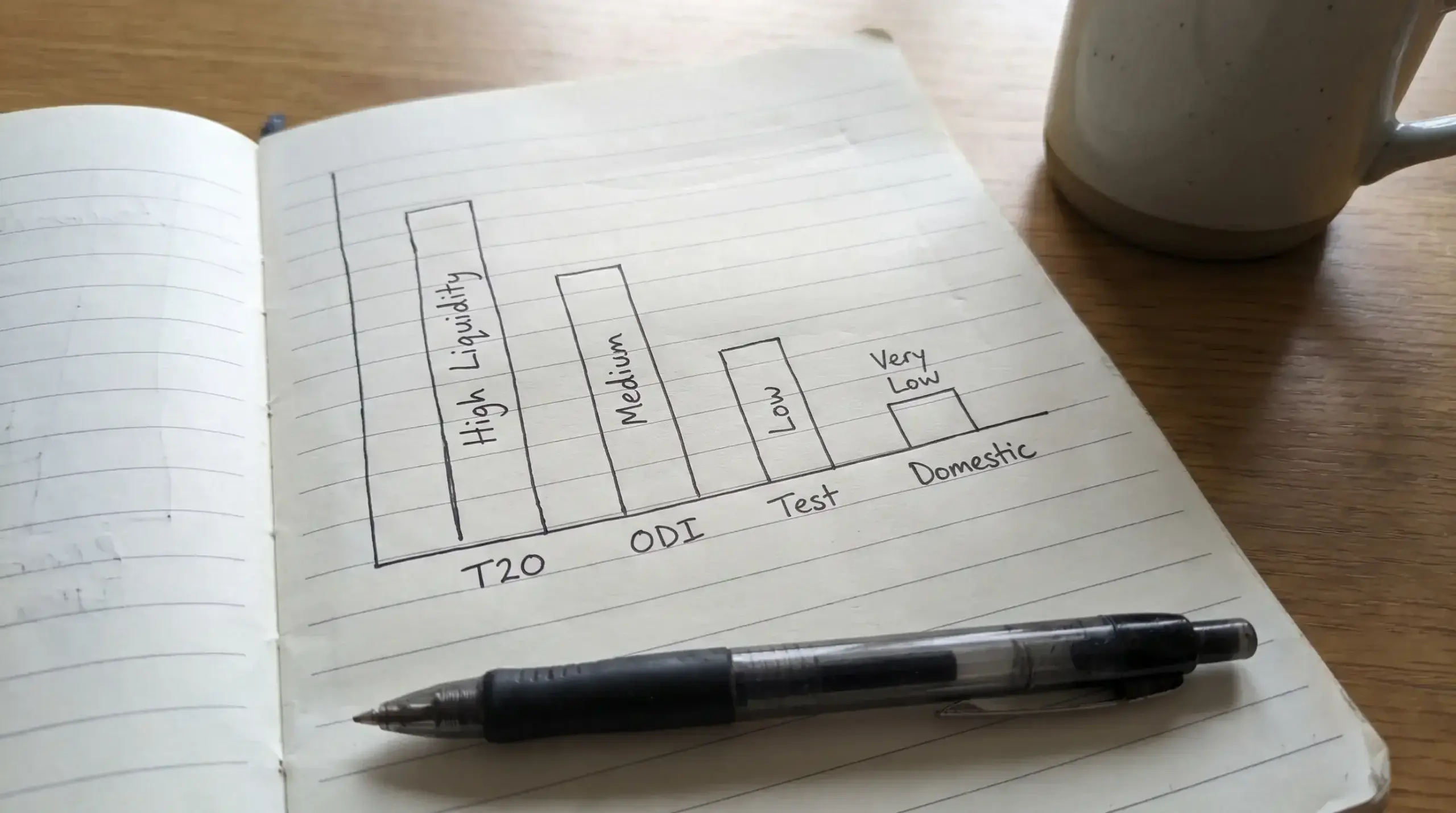
Test cricket is structurally lower liquidity than the white-ball formats. A single session of a Test produces less price movement than an entire T20 innings, which means the order book has less reason to refresh. Test Match Winner liquidity sits around £20,000-100,000 depending on the marquee value of the fixture. That’s enough for casual punters but starts to feel thin for anyone trying to place a meaningfully large lay.
County cricket – Championship and Blast – has the lowest cricket exchange liquidity in the UK calendar. A Blast group game might see £5,000-15,000 matched on Match Winner. A Championship game often sees less. Liquidity at this level means individual lays of meaningful size will move the price visibly, and you need to size your bets to the available depth rather than the maximum you’d ideally want to stake.
Commission and what it actually costs you
Exchanges take a commission on net winnings. The standard UK exchange commission rate is 5% on a winning position, though some operators tier the rate based on volume – heavier traders pay less, casual users pay the headline rate.

Commission applies to winnings, not to stakes. A £20 back bet at 2.50 returning £50 – that’s £30 of profit, on which 5% commission = £1.50. Your net return is £48.50 instead of £50. If your bet loses, no commission applies.
The 5% commission rate sounds small until you compound it. Across a hundred winning bets at typical prices, the commission drag costs roughly 1.5-2% of total turnover. Compared to a sportsbook with a 4-8% overround built into prices, the exchange is still meaningfully cheaper across the long run – but the gap narrows once you account for commission.
The volume-tier discounts matter for higher-stake punters. Most UK exchanges offer reduced commission rates of 2-3% for high-volume users, which makes a real difference over a season. If you turnover £10,000 a year through the exchange, the difference between the headline 5% rate and a 2% tier is several hundred pounds.
Commission can also vary by market and by promotion. Some exchanges run commission-free promotional periods on specific tournaments. Some apply higher commission to in-running markets versus pre-match. Read the operator’s commission page – the rate isn’t always what the marketing suggests.
Where the exchange wins and where it doesn’t
The exchange wins on price tightness, on the ability to lay, and on the transparency of the order book. It loses on liquidity in less-watched fixtures, on user interface complexity for new bettors, and on the smaller range of secondary markets and bonus features that sportsbooks offer.

For most UK cricket bettors, the right answer is to use both. Sportsbooks for builder slips, promotional value and the secondary prop boards. Exchange for Match Winner pricing on big fixtures, for lay positions, and for any time you want to take a properly-sized stake without paying the sportsbook overround. The two products solve different problems, and treating them as alternatives rather than complements leaves money on the table either way.
