
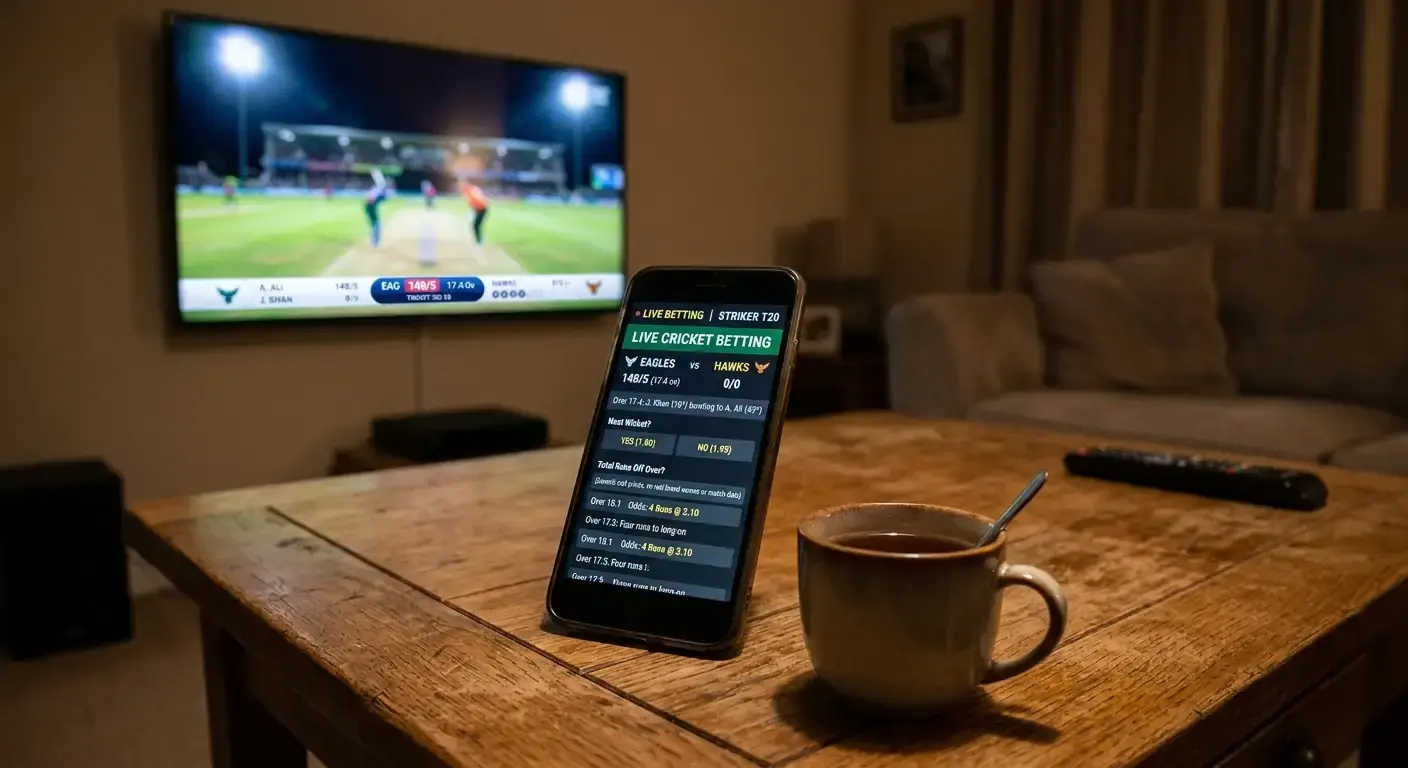

The over I lost in the time it takes to make tea
The cleanest example I can give of how fast in-play cricket moves came in a Big Bash match a few seasons back. I had laid a side at 1.5 just before the eighteenth over. I went to make tea. When I came back maybe four minutes later, my position had gone from green to red, then back to green, then red again. Two boundaries, a wicket, a wide-and-a-six combination, and one half-decent over from the back-end death bowler had moved the price across roughly a 30% swing. I had not watched a single ball.
That story is the entire premise of this guide. In-play cricket betting is a different product from pre-match cricket betting. Different pace, different psychology, different operator infrastructure, different rules about settlement and suspension. Online platforms account for 67.5% of the global sports betting market in 2025, and a sizeable slice of that is in-play turnover. Cricket sits among the formats that have leaned into live markets hardest — particularly The Hundred, with its Sky Sports group-stage audience up 38% year on year in 2025, and a market structure built for app-driven, ball-by-ball trading.
What follows is a working walkthrough of how live cricket markets actually behave, where the mechanics catch out new in-play bettors, and what discipline genuinely separates the punters who profit from in-play from the punters who donate to it.
How a live cricket market actually updates
The pricing engine behind a live cricket market is doing more arithmetic per second than most bettors realise. Every ball produces a settlement event: runs, dot, wicket, wide, no-ball. Each of those events updates the model’s estimate of the most likely match outcome. The model then updates every published price — match-result, run-line, total runs, top batter, top bowler, every player prop, every session market, every over-by-over derivative — based on the new estimate.
That update happens within a window operators measure in low single-digit seconds. The price you see on the screen lags the ball you saw on the broadcast — sometimes deliberately, to absorb stream delay, sometimes simply because the model is processing. The lag is meaningful. A ball that has clearly been bowled and clearly produced a four is settled in the punter’s view but may not yet be reflected in the published price for another two to four seconds. Suspension — where markets are pulled offline temporarily — is the mechanism operators use to prevent stake going in during that window.
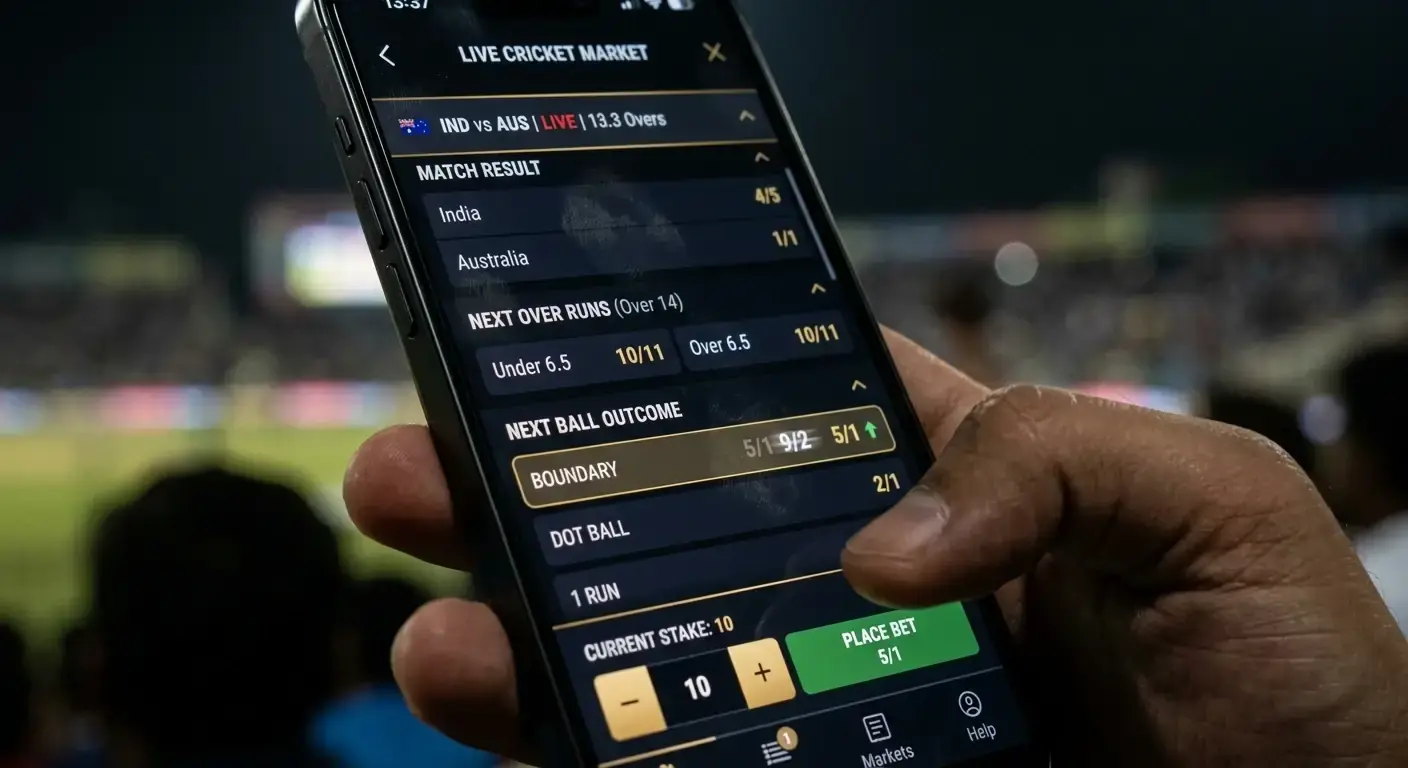
The honest read is that a live cricket market is a continuous algorithmic re-pricing event with brief, deliberate pauses for the human consumer. You are not betting against a bookmaker in the traditional sense. You are betting against an algorithm that updates faster than you can think, with a small lag window the operator manages to protect itself, not you.
Next-over and next-ball markets: the engine room of in-play volume
Next-over runs is the market that defines modern in-play cricket. It is settled at the end of the over, it resets every six balls, and it produces six or seven independent betting events per match. Multiply by the number of in-play products around it — next-over wickets, next-over fours, next-over sixes, next-over wides, runs in the first three balls of the over — and a T20 match generates several hundred discrete in-play settlement events.
The next-over runs line typically opens about thirty seconds before the over starts, depending on the operator’s process. The line reflects the model’s view of the bowler-versus-batter matchup, the game state, the ball age, and the pitch behaviour observed so far. A line of “9.5” on a death-over with a specialist death bowler and a settled batter is a different bet from “9.5” on a powerplay over with a new ball and a tail-ender at the crease — same line, different implied probability, because the variance distributions are different.
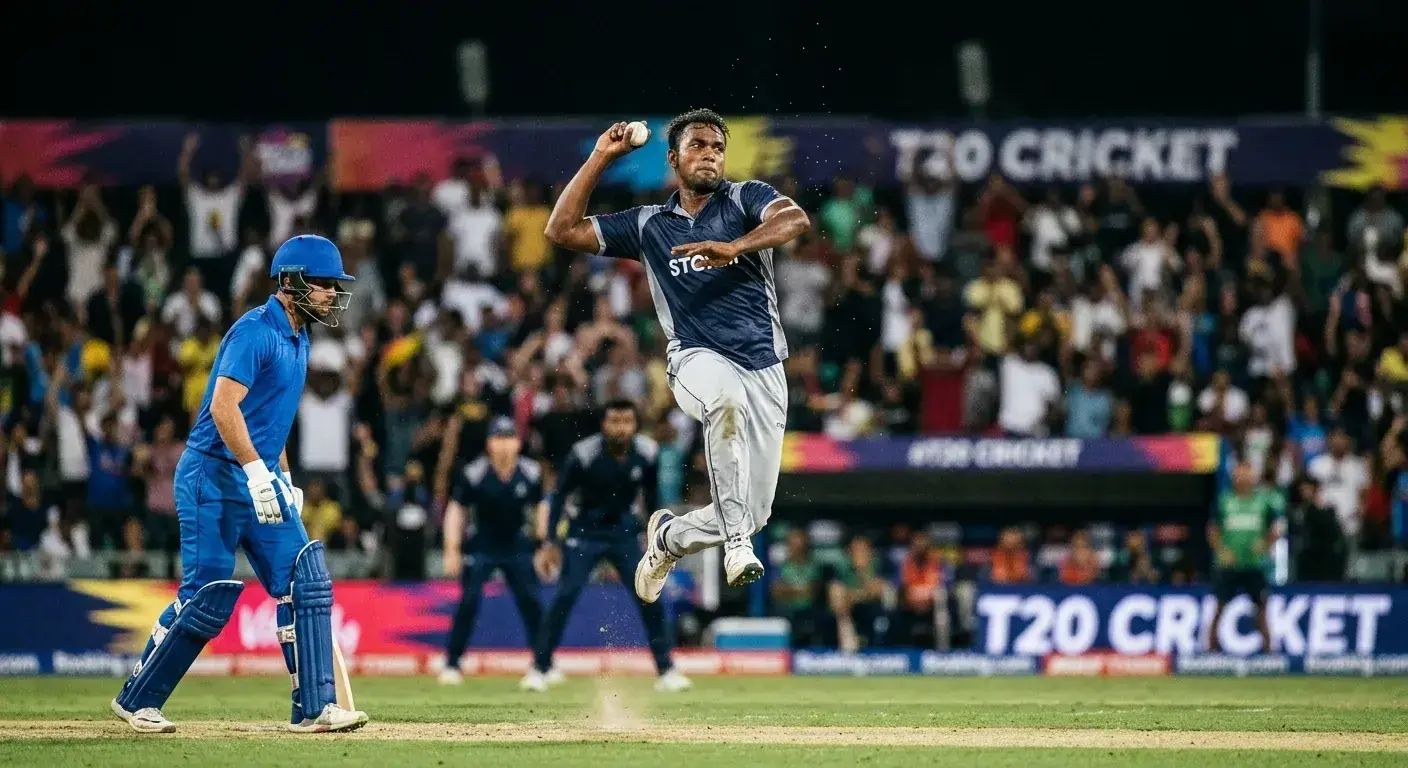
Next-ball markets — six or four off the next delivery, dot ball next, wicket next — are the most volatile products on the in-play menu. They resolve every six seconds in active play. They have the highest bookmaker margin on the entire cricket coupon, often north of 12%. And they generate, by raw count, the most “what just happened?” panic moments. A next-ball six market is essentially a coin flip dressed up as a cricket bet — the probability of a six on a given delivery is so context-dependent that operators load margin heavily to compensate.
The discipline on next-over and next-ball markets is to play them selectively. The operator’s edge compounds across hundreds of low-margin decisions, and trying to win on these markets through sheer volume is the most reliable path to a depleted bankroll I have ever observed.
Partnership and session markets live
Partnership markets — runs scored by the current pair before one of them is dismissed — are an underappreciated in-play product. They settle on the next wicket, which means they have a clear, definable endpoint. A partnership market opened with a new pair at the crease is a clean bet on how long the pair will last and how aggressively they will play.
The pricing logic on partnership markets gives the model less to work with than over-by-over markets do, which means the spread between operator estimate and true probability can occasionally widen. A new opening pair on a flat track, with the new ball doing nothing and the field in for catches, is a different partnership profile from a recovery pair coming together at 60 for 4. Operators price these correctly most of the time, but the moments where they do not are the ones a careful punter looks for.
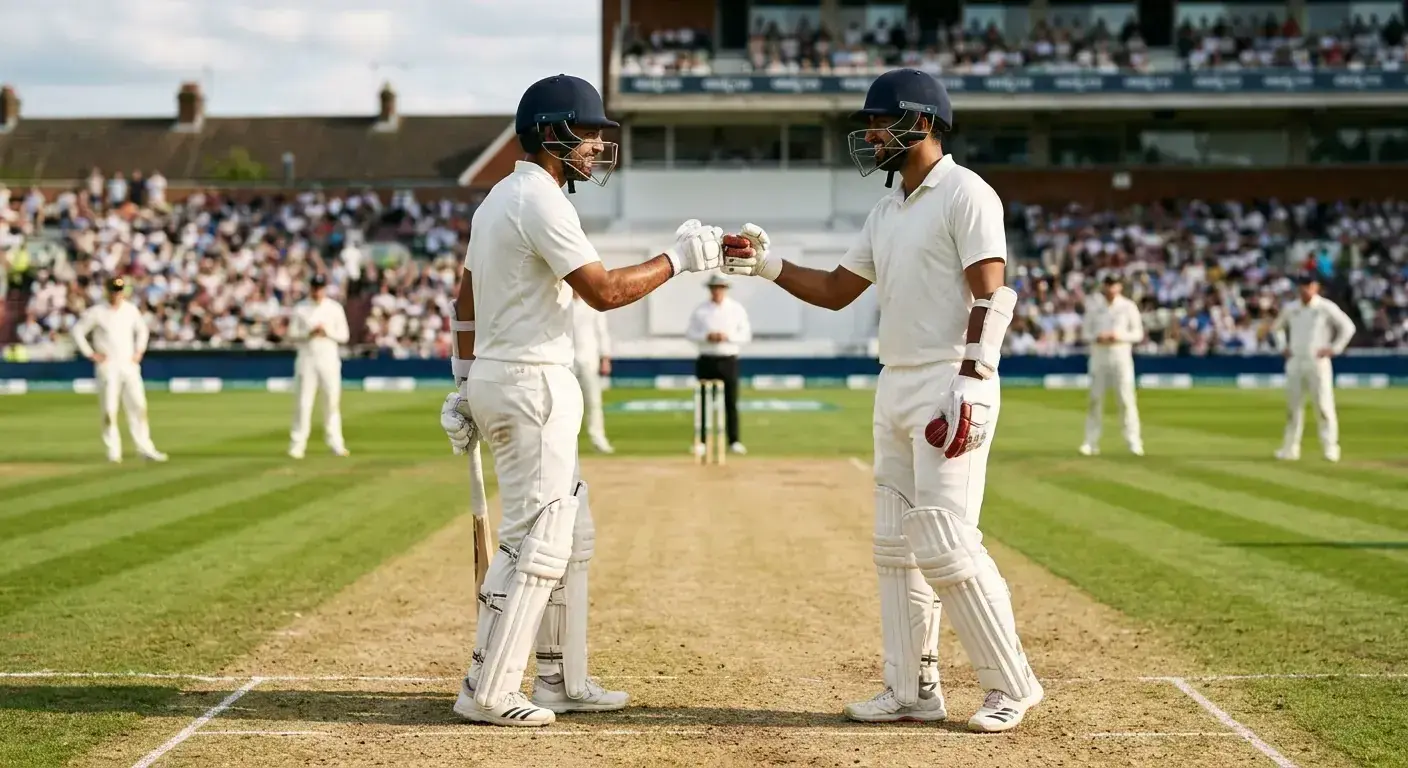
Session markets, in their live form, are simpler than they look. A Test session market — total runs in the morning session — runs from the first ball of the session to the final ball or the next break, whichever comes first. The price moves with every ball, with every wicket, and particularly with weather signals. A morning session that opens at 95.5 runs, with twenty overs left and the score on 80 for 2, is a different bet from a market that has stayed at 95.5 through ten overs of 4-an-over scoring. The line should have moved; if it has not, either the operator is slow or there is a non-obvious reason — bad light, a bowling change coming, a strategic accelerator at the crease who has not yet hit the gas.
Live session pricing on Test cricket is generally sharper than on T20 because Test sessions are longer and the model has more data to work with. The thinnest pricing — where the operator’s edge is highest — sits on the equivalent products in T20, where the entire innings might last shorter than a Test morning session and the line has to be set fast.
Latency, stream delay, and suspended markets
This is the section every new in-play bettor should read twice. Stream latency — the gap between an event happening on the field and the event reaching your screen — varies between three and twenty-five seconds depending on your viewing source. Broadcast TV typically runs at three to six seconds. Operator streams typically run at eight to fifteen seconds. International signal feeds at smaller events can run longer. That delay is your enemy on next-ball and next-over markets, because the operator’s pricing model is working from a feed closer to real-time than your view.
Market suspension is the operator’s tool for managing the latency gap. When a ball is bowled, most operators suspend in-play markets briefly while the ball is settled, the next price is calculated, and the market is reopened. The suspension window is usually three to six seconds. During that window your stake cannot be placed and any active bet cannot be cashed out. You see a brief “suspended” notice or the bet button greys out.

Suspensions also happen for off-field events. A bowling change, a drinks break, a DRS review, a brief weather interruption — all can trigger suspension. The duration varies. A DRS review is typically a sixty-to-ninety-second suspension on all related markets while the third umpire works through replays.
The practical consequence is that your timing window for in-play action is narrow and unpredictable. A bet you decided to place at the start of an over may not be possible to place by the time you find the button. A cash-out value you saw a moment ago may not be available when you reach for it. This is a feature of the product, not a bug, and the punters who succeed in-play work with it rather than against it.
Cash out mechanics: how the value is calculated
Cash out is, in my view, the most misunderstood feature on a UK cricket coupon. The basic concept is simple — close out a bet before settlement at the operator’s current value. The arithmetic is harder.
The cash-out value on a single bet is, roughly, the current implied probability of your bet winning multiplied by your potential return, minus the operator’s cash-out margin. On a £10 bet at 4/1 with current implied probability of 50%, the rough cash-out value is around £24, with the operator typically taking a cash-out margin of 5–8% out of that — so you might see £22 offered. That margin is the bookmaker’s edge on the cash-out, and it is in addition to the original market margin you paid when placing the bet.
Cash-out value moves continuously through the match. A back bet that started looking unlikely and is now looking likely will offer a cash-out value above your stake. A back bet that has gone against you will offer below stake. The value will keep moving with every ball, every wicket, every weather signal. Some operators offer partial cash-out — closing out part of the stake while leaving the rest live — which is a useful tool for punters who want to lock in a guaranteed minimum while preserving upside.

The trap on cash-out is that the operator’s margin embedded in the value is invisible. A cash-out offered at £22 on a position the model values at £24 looks like a fair number. The operator’s cash-out engine is designed to be slightly conservative — to leave a margin in the operator’s favour — and on accumulated cash-out decisions across many bets, that margin compounds in exactly the same way pre-match margin does. Cash-out is a tool, not a free option.
Cash-out is not available on every market. Some narrow markets and most ante-post outrights do not offer cash-out. Some operators suspend cash-out on integrity-flagged matches. Live in-play markets, by contrast, offer cash-out almost universally, including partial cash-out on most product types.
Live streaming and the watch-and-bet experience
Live streaming on UK betting sites varies enormously by operator and by tournament. The Hundred 2025 saw Sky Sports group-stage audiences up 38% year on year and BBC Sport recording 2.2 million online viewing requests, up from 1.6 million in 2024 — those are broadcast numbers, not betting-site stream numbers. The betting-site streams for The Hundred, where they exist, are an additional layer on top of the broadcast distribution.
The mechanics of betting-site streaming are constrained by rights. UK operators that offer cricket streams have negotiated specific rights for specific tournaments. Coverage is rarely universal. A site might stream the IPL but not the BBL, or the SA20 but not the ILT20. The patchiness is structural, not a flaw. Operators license what they can monetise, and the rights structure for cricket streaming on UK betting sites I cover in a dedicated piece on streaming rules.

The latency of operator streams is the practical issue. As I mentioned earlier, operator streams typically run at eight to fifteen seconds of delay versus broadcast. If you are watching the same match on Sky and on the operator stream, the broadcast will be ahead by several seconds. The pricing engine is working from the lower-latency feed, which the operator controls. That gives the operator a structural information edge over the punter who watches only the operator stream — they see what is happening sooner than you do.
For the punter who already pays for Sky or for the relevant rights holder, the practical advice is to watch the broadcast, not the operator stream, when betting in-play. You will be roughly aligned with the pricing engine’s data feed, which closes the information gap. For the punter who only has access to the operator stream, the realistic advice is to slow down — give yourself an extra second or two before placing live stakes, because you are working from a delayed feed.
How format drives live volatility
The volatility of an in-play cricket market scales with how much a single ball can change the implied probability of the match outcome. That volatility is highest in short formats and lowest in long ones. A T10 game runs at maximum live volatility — every ball can swing match-result probability by several percentage points. A T20 game is slightly less volatile per ball but extremely volatile across an over. The Hundred sits between T20 and T10 on the volatility spectrum, weighted slightly toward T10 because its 100-ball innings is shorter than T20.
Test cricket runs at the lowest live volatility, because a single ball in a five-day game rarely shifts match-result probability by more than a fraction of a percent. That low volatility is why Test in-play menus look thin compared to T20 — there is less for the market to chew on, less reason for prices to move ball-by-ball. The volatility shows up at session boundaries, at the new ball, at the fall of a top-order wicket, and at weather signals.
The audience implications matter. 31% of The Hundred’s fanbase is aged 18 to 44, against 24% across UK cricket fans generally — a younger demographic that is more accustomed to app-driven, high-cadence interaction. That demographic gravitates to the most volatile in-play products. The older Test cricket audience — over 40% of fans aged 65 or older — plays a different in-play product entirely: longer-form session bets, partnership totals, fall-of-next-wicket markets. Two formats, two in-play styles, same operator infrastructure.
For a punter, the volatility scaling has a practical consequence. The higher the format’s live volatility, the more important your decision-making speed becomes — and the more important it is to know your maximum stake in advance, before the heat of the over hits. The lower the volatility, the more you can think your way to the bet. Different formats reward different cognitive styles.
Live bettor discipline: the part that does not appear on the screen
Grainne Hurst, CEO of the Betting and Gaming Council, said in 2025 that having the evidence base to counter some of the myths, misconceptions and quite frankly lies that you read in the media sometimes was really important — a piece of context worth keeping in mind when reading any single piece of advice on in-play betting, including this one. The honest position is that in-play cricket betting attracts a higher proportion of the casual money than pre-match cricket does, and the bookmaker’s edge is structurally higher on most in-play markets than on pre-match. That maths does not change because anyone wishes it would.
The discipline that works for live cricket is, in my reading, three things. First, pre-decide your maximum stake on each market type before play starts, and treat that as a hard cap. Pre-match planning compounds; in-play impulse decisions compound the wrong way. Second, watch one stream — broadcast or operator, not both — so that your data feed is consistent and you are not bouncing between two views of the same match. Third, leave next-ball markets alone unless you have a specific, articulable reason. The margin is too high, the variance is too sharp, and the dopamine cadence is engineered to keep you on the screen.
The smaller things matter too. Deposit limits configured in calm moments hold up better than ones set under pressure. Loss limits set per session — not per day or per month — bind closer to the in-play decisions you actually make. Self-imposed cool-down periods of fifteen minutes after a heavy in-play stretch reset the cognitive load enough to make the next decision usable. None of these are gimmicks. They are the working tools every long-term in-play punter I respect uses, and the operators that take their licensing obligations seriously make all of them available without friction.
Live cricket betting is one of the most genuinely engaging products in sports betting. It is also one of the products where the operator’s edge compounds fastest against unaware punters. The two facts coexist. The punters who treat in-play as a tool for executing pre-formed reads — rather than as a slot-machine adjacent to a cricket broadcast — are the ones who survive the format. The ones who treat it as continuous decision-making with no constraint donate steadily. That divide is the most useful thing I can leave you with.
