

The big tournaments that bring everyone in
The first ICC World Cup I bet on was the 2011 ODI tournament. I backed India outright at 5/1 on the morning of the opening game and forgot about the slip for six weeks. The point of that story isn’t the win – it’s that ICC events are the only cricket tournaments where casual UK punters reliably place outright bets and hold them all the way to the final. That behaviour shapes everything about how these markets are priced.
This walkthrough covers what’s actually different about betting an ICC event from the UK, where the markets reward attention, and what to do when weather wipes out half a knockout day.
The ICC event calendar and why it matters
The ICC runs a small portfolio of major tournaments: the ODI World Cup roughly every four years, the T20 World Cup every two, the Champions Trophy reintroduced for ODI cricket, and the Women’s T20 World Cup on its own cycle. Each one pulls a different shape of betting volume.

The ODI World Cup is the largest betting event in cricket outside the IPL. A typical tournament moves tens of millions in turnover through UK-licensed operators alone, which makes it second only to the IPL in cricket betting volume. The global sports betting market hit USD 100.9 billion in 2024 and is on track to reach USD 187.39 billion by 2030, with Europe holding around 48% of revenue. UK punters are a meaningful slice of that European share, and ICC events are when most of that audience touches cricket.
The T20 World Cup brings a different audience. Shorter games, more matches per day, broader country participation. The 2024 edition spread across the West Indies and USA with 20 teams in the field, which is roughly double the ODI World Cup format. More teams means more group games, more upsets, and a longer window for outright market re-pricing.
Champions Trophy is the smallest of the three major ODI competitions but the sharpest market. Eight qualifying teams, fifteen group games and four knockouts compressed into three weeks. The tournament rewards patient outright betting because the small field doesn’t allow much room for upsets in the knockout phase.
The UK-specific structural fact is that ICC events generally play in time zones that suit live afternoon and evening UK viewing – Asian and Australasian tournaments push games into UK morning and afternoon, while West Indian and American tournaments are evening cricket. Either way, live betting volume is high across the entire tournament window.
Outright tournament winner pricing
The ICC outright market opens months before the tournament begins and runs until the final ball. The interesting feature is the price drift across the qualifying period – teams that struggle in their final pre-tournament ODIs see their outright prices lengthen by 30-50% relative to where they were a month earlier. That drift is partly real (form matters) and partly noise (small sample sizes from a handful of warm-up matches).
I treat the pre-tournament outright as a poor-value bet for the same reasons I avoid the Ashes outright. Six weeks of cricket compressed into a single price is a low-information question, and the bookmaker’s overround on a ten-team or twenty-team outright is uncomfortably wide – typically 115-120% combined implied probability.
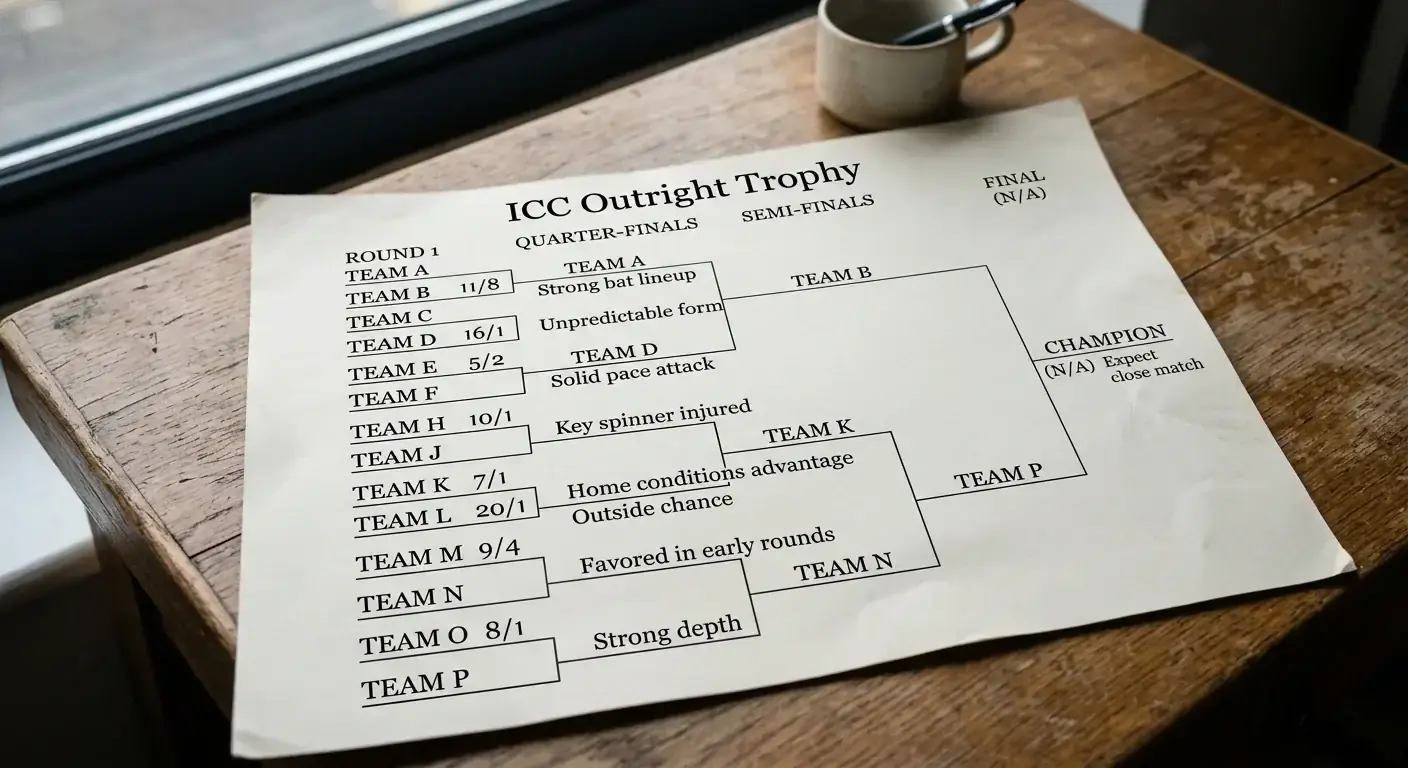
What pays is the post-group-stage re-pricing. By the time the knockout bracket is set, the market has watched 30-50 group matches, the qualifying teams are known, and the outright re-rates dramatically. A team that’s gone undefeated in the group stage might shorten from 5/1 to 9/4 in the 48 hours between the last group game and the first quarterfinal. A team that scraped through on net run rate after losing two key games might drift from 7/1 to 14/1.
Top Tournament Run Scorer and Top Tournament Wicket Taker outrights pay through the full tournament. The runs market is the more reliable bet because it rewards a single attribute – being a top-three batter who plays every match. The wickets market is noisier because bowler workload varies more across knockout rounds, and a single five-wicket haul in the semi-final can swing the title.
Group stage and qualification markets
Group stage matches in ICC events are the most reliably mispriced cricket of any calendar year. The reason is selection variance – teams routinely test fringe players, rest senior bowlers in pool fixtures, and approach individual matches with the tournament as a whole in mind. That produces match outcomes that look closer than the raw team strength suggests.
To Qualify for Knockouts is the workhorse group-stage market. Eight teams qualify from sixteen in a typical ODI World Cup; eight from twenty in a T20 World Cup. The qualification market is structurally short on top-five teams and longer on mid-tier sides, which is correct – but the size of the price gap between, say, the sixth-favourite and the seventh-favourite often overstates the actual probability gap.
Group Winner markets are tighter and reward squad-shape reading. The team that wins a group usually goes unbeaten or drops a single low-stakes game, which means the market is essentially pricing “which team will be most consistent across five or six pool matches”. That’s a question with a real, knowable answer if you’ve watched the recent ODI form of each side.
Knockout pricing and where the market gets it right
Knockout games are priced sharply. By the time the quarterfinals start, the field is small, the data is rich, and the bookmaker overround has compressed to around 104-106% on Match Winner – comparable to a big IPL game.
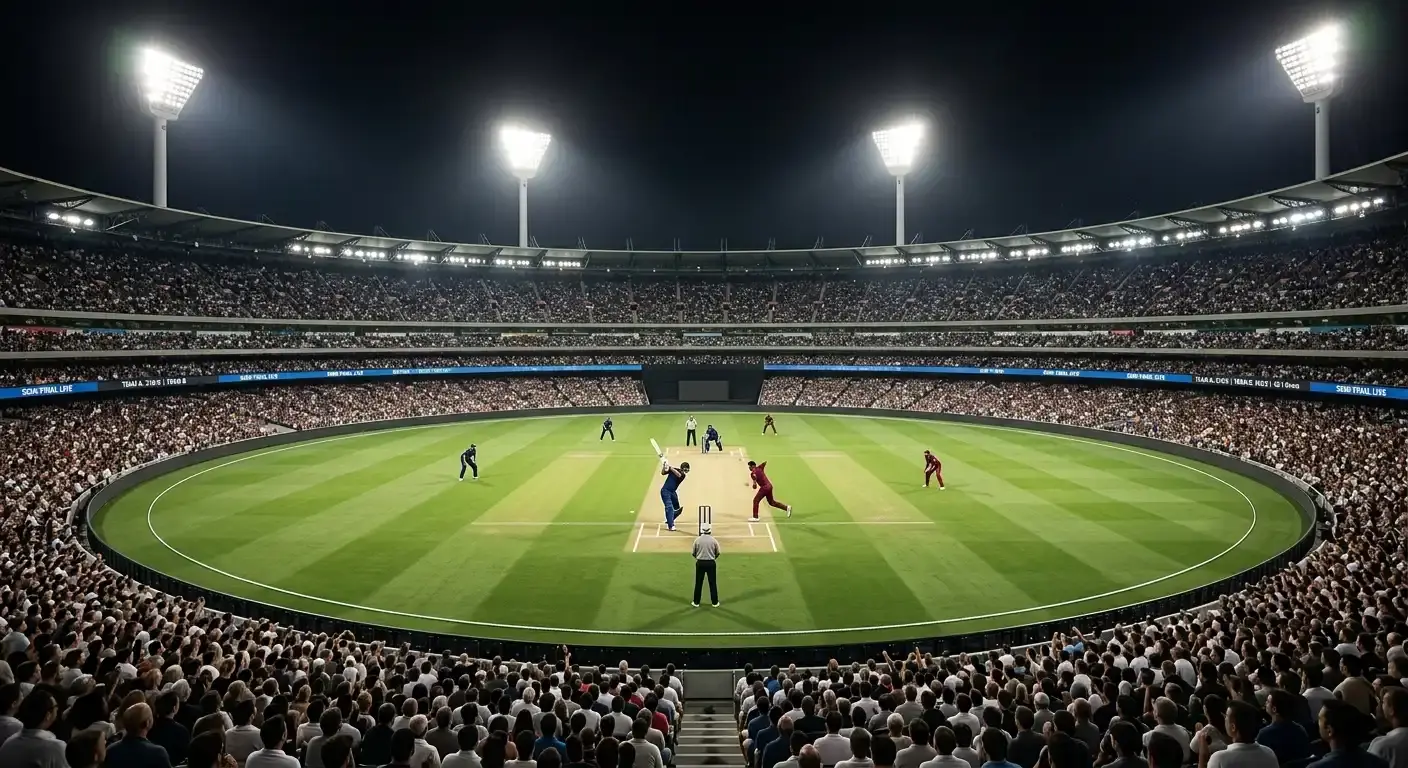
That said, knockout cricket carries a particular kind of variance. One-day cricket compressed into a single 50-over or 20-over game, with conditions sometimes radically different to what the qualifying side has played in the group stage, produces upsets at a rate that catches out punters who back the favourite by reflex. The historical hit rate of the pre-tournament favourite winning the ICC ODI World Cup is below 40% – most editions are won by a team priced at 4/1 or longer at the start of the tournament.
For betting the bracket itself, the structural advice is simple: bet individual matches, not paths. Backing a team to “make the final” in a four-round knockout asks you to be right four times in a row about games that the bookmaker has already priced as roughly coin-flips. The same outright probability is much cheaper to assemble from individual match bets across the bracket, and you get to update each one with actual cricket.
For the broader mechanics of ICC outrights – including how dead-heat rules apply when two players share an award, and how ante-post bets settle when team composition shifts – the deeper read on outright cricket tournament bet rules covers the operator-side rules that decide what your knockout outright actually pays.
Weather, washouts and how knockouts get rescued
Every major ICC tournament has at least one knockout match seriously threatened by weather. The host body builds reserve days into the schedule for semi-finals and the final, but quarter-finals usually only have a partial reserve allocation, and group-stage games often have no reserve day at all.
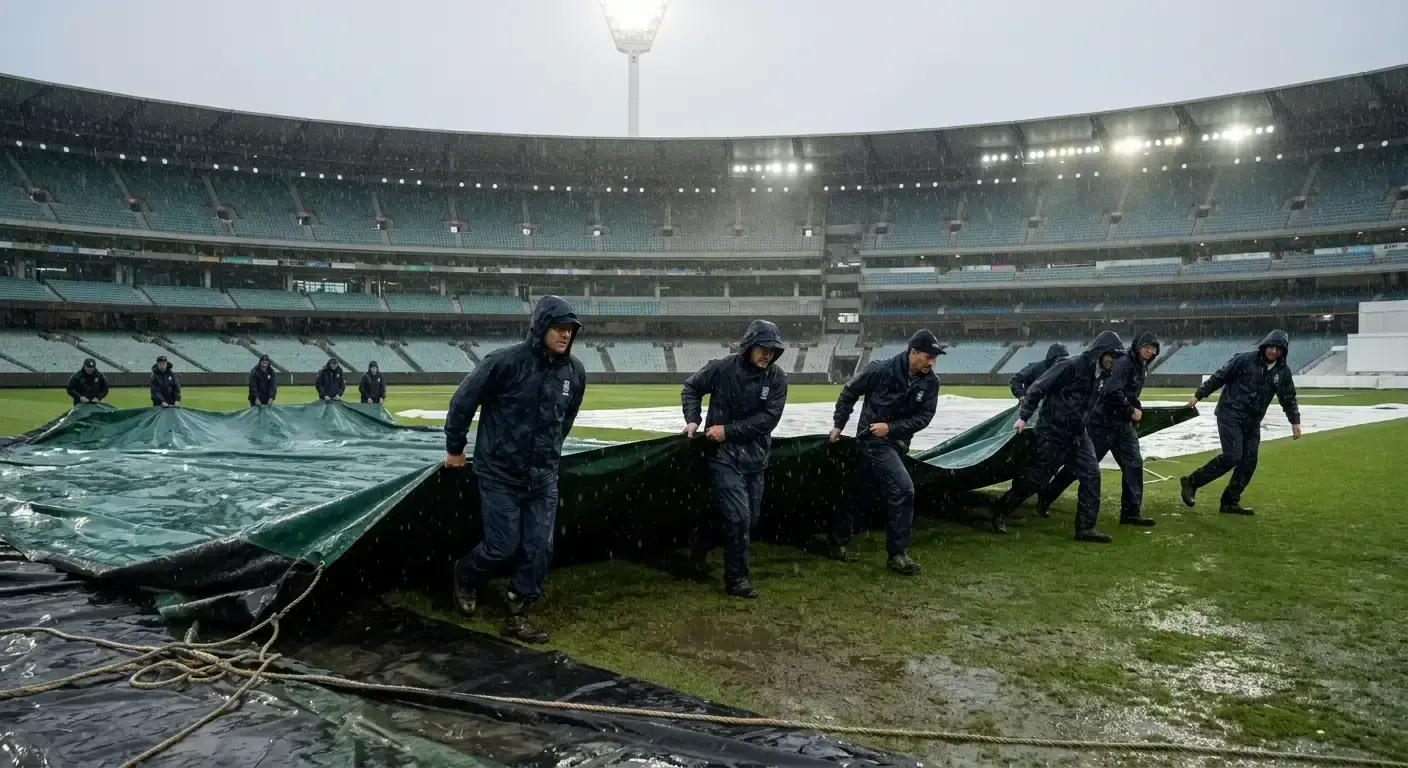
What happens to your bet in a washout depends on the specific market and operator. Pre-match Match Winner usually voids and stakes are returned if no result is achieved. Outrights generally pay out on the team that wins the tournament regardless of how many washouts the bracket required to get there. Top Tournament Runs and Wickets markets are settled on the actual matches played, not on a notional full schedule.
The dangerous market in a washout is anything tied to a single match that doesn’t reach DLS minimum overs – typically twenty overs per side in ODI, five overs in T20. If the minimum isn’t reached, the match is voided for Match Winner purposes. If it is reached, DLS produces a result and most bets stand. That five-over threshold is the difference between losing your stake and getting it back, so it pays to know exactly when DLS kicks in for the format you’re betting.
Why ICC tournaments reward the patient punter
ICC events are the cricket calendar’s main moment for casual betting volume. That casual volume creates the prices the patient bettor exploits – the early outright over-bet on the headline favourite, the group-stage underestimate of a middle-tier side, the knockout-bracket compounding fallacy that has people backing the path instead of the match. None of this is hidden. It just requires the willingness to bet less often and wait for the genuinely mispriced lines.