


How cash out value gets built
Cash-out is the operator offering to settle your bet early at a price that reflects the current probability of your bet winning. The maths is straightforward in principle: if your bet would return £100 and the bookmaker now thinks the bet has a 60% chance of winning, the fair value of an early settlement is £60. The cash-out price you actually see will be a little lower than that – say £55 – because the operator builds in a margin on the cash-out value, the same way they build margin into the original price.
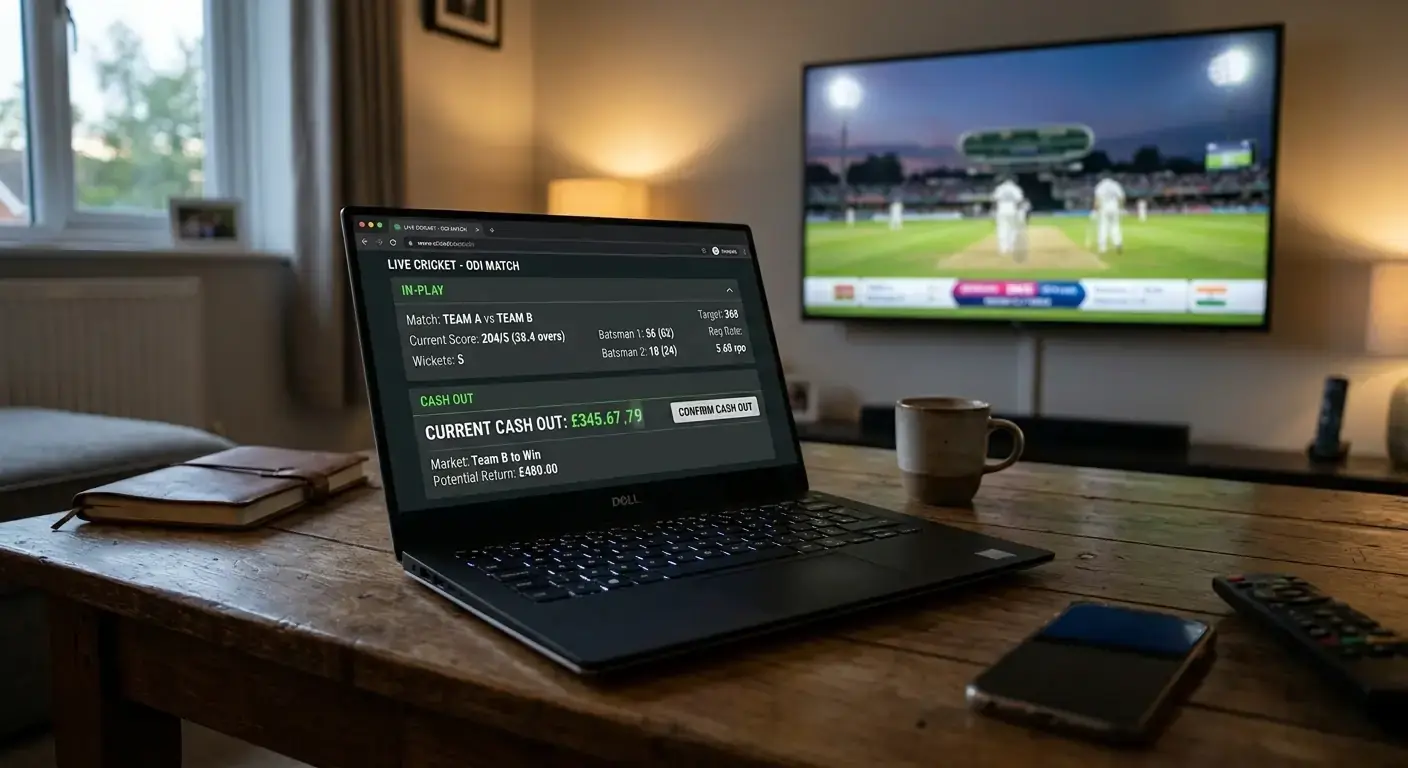
That margin is the cost of convenience. Every cash-out you accept transfers a small amount of expected value from you to the operator. Across thousands of cash-outs, that transfer is meaningful. The structural reason cash-out is profitable for bookmakers is that punters tend to take it disproportionately when they’re winning – locking in profit feels safe – and that asymmetric usage gives the operator a reliable margin draw.
The cash-out value moves in real time as the match progresses. Backed England at 7/4 pre-match, and they’re 80-0 after ten overs? The cash-out value climbs because England’s win probability has gone up. Backed England, and they’re 30-3 after ten overs? Cash-out value crashes – sometimes to single pence on the pound – because the win probability has fallen off a cliff.
One important nuance: cash-out can be suspended even when the underlying market is live. Bookmakers freeze cash-out during specific events – typically between deliveries when a wicket has fallen, during DRS reviews, or when the trader needs to recalculate prices after an injury or weather delay. The frozen value isn’t a glitch; it’s the operator protecting itself from settling at the wrong number.
Partial cash out and what it actually does
Most UK-licensed operators now offer partial cash-out – the ability to take some of your potential return now while leaving the rest of your stake running. The mechanism is simple: you nominate a percentage to cash out, the operator settles that fraction at the current value, and the remainder stays live at the original price.

Worked example. £20 back at 4.00, so a potential return of £80. Cash-out value mid-match is £60. You take a 50% partial cash-out, which settles £10 of stake at the current value – you receive £30 now (50% of £60). The remaining £10 of stake continues running at the original 4.00 price, so it returns £40 if the bet wins or zero if it loses.
Partial cash-out is genuinely useful for stake management. It lets you lock in some realized profit while keeping skin in the game on the original bet. The structural drag – the operator’s margin on the cash-out value – applies only to the portion you cash out, not to the remainder. That makes partial cash-out cheaper, in expected value terms, than a full cash-out.
The trap with partial cash-out is the temptation to keep doing it. Taking 25% out at lunch, another 25% at tea, another 25% at stumps – by the time the bet settles, you’ve paid the cash-out margin four times instead of once. The most efficient use of partial cash-out is a single decision point, not a rolling drawdown.
Suspended cash-out during play
Cash-out value disappears during the moments when the match is most pivotal. A wicket falls and cash-out suspends. A DRS review starts and cash-out suspends. A rain delay begins and cash-out suspends. The pattern is consistent across UK operators: cash-out goes dark when prices need to update.
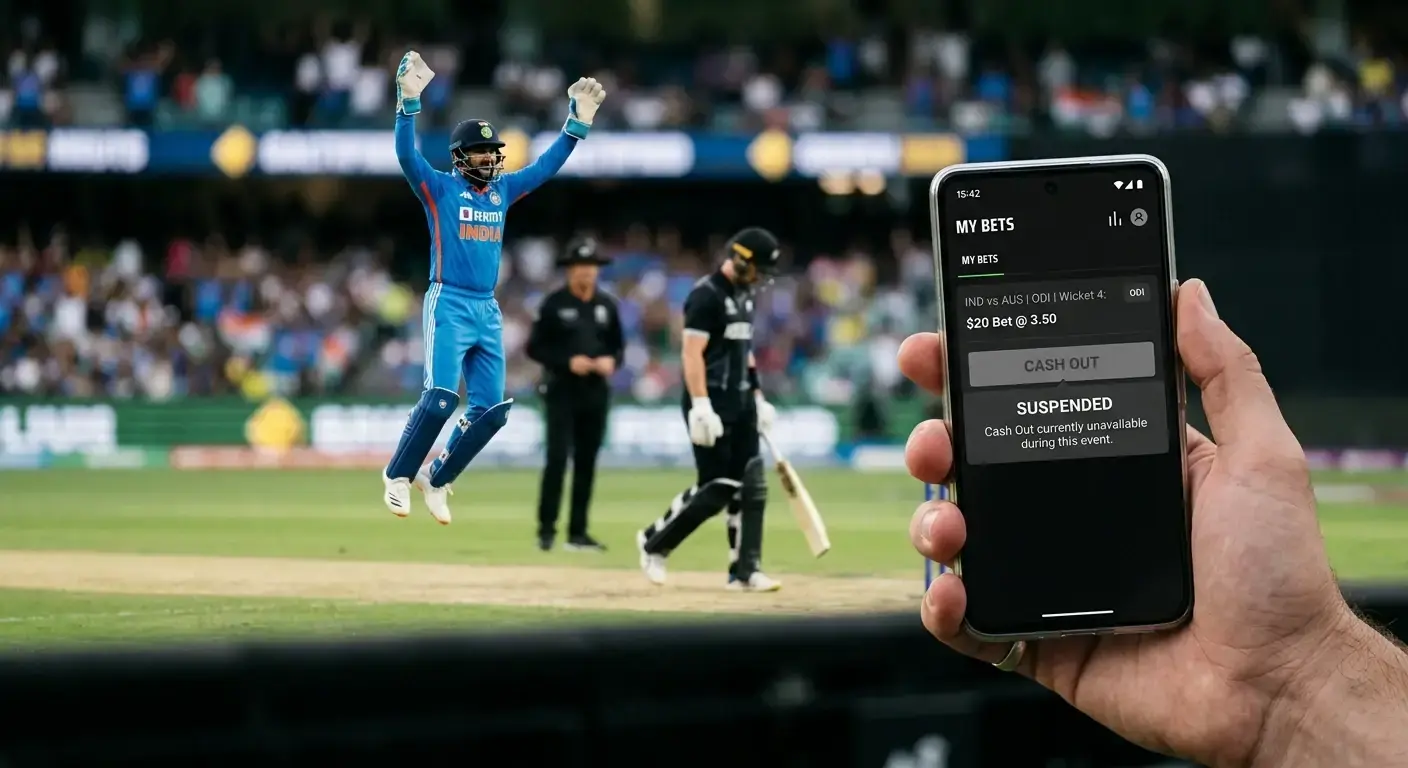
The suspension is short – usually 15 to 60 seconds – but it can feel longer when you’re watching a price you wanted to lock in disappear from the slip. The structural reason for the suspension is risk management. If the operator left cash-out live during a wicket review, savvy punters with faster feeds than the operator’s system could grab favourable cash-out values before the price updated.
What this means in practice: don’t plan to cash out exactly at a moment of uncertainty. If you want to take a value, do it during a settled phase of play – between overs, after a boundary has been processed, during a strategic timeout. The cash-out button works most reliably when nothing pivotal is happening on the pitch.
For the full picture of how live cricket markets behave during these suspension moments – and why ball-by-ball pricing creates the gaps cash-out responds to – the in-play cricket betting walkthrough covers the mechanics of how live markets suspend and resume.
When cash out is bad value
The honest summary: cash-out is bad value most of the time. The operator’s margin sits on every cash-out value, and over a long enough betting career, taking cash-out reliably loses you a measurable amount of expected return compared to letting bets run.
The specific situations where cash-out costs the most are easy to identify once you know what to look for.
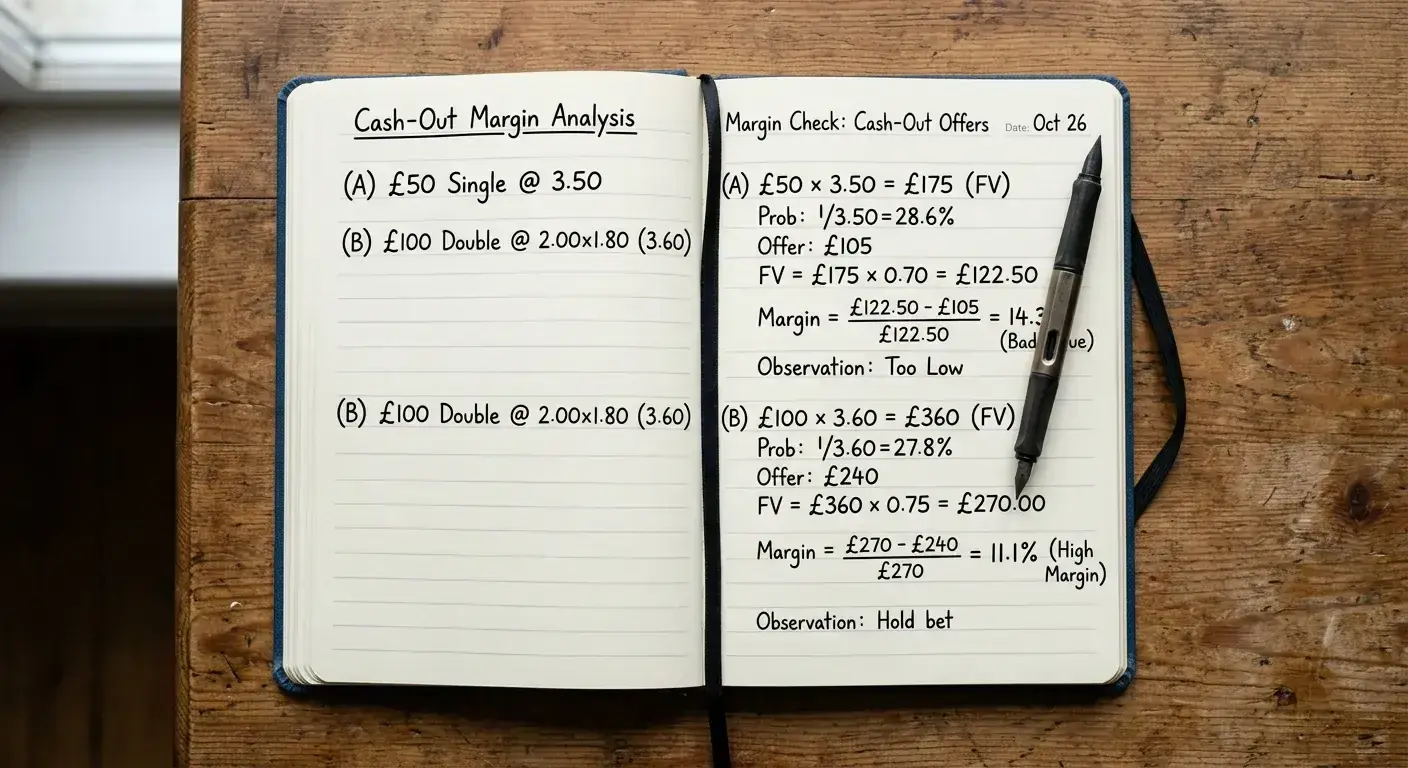
First, cash-out on outrights and ante-post bets. A pre-tournament outright that’s now midway through the event has the widest cash-out margins of any market – the operator knows the punter is emotionally committed to the bet and will accept a worse-than-fair offer to lock in.
Second, cash-out on long-odds bets when they start winning. A 20/1 outright that’s now odds-on to win still has substantial upside remaining, but the cash-out value typically offers something like 70-75% of the potential return. Backing yourself to ride out the last 25% is usually the better play.
Third, cash-out on bets that have moved significantly against you. The temptation is to take whatever cash-out value remains to recover some loss. The operator margin on a 5% cash-out value is, in proportional terms, much wider than on an 80% cash-out value. You’re paying disproportionate margin for the privilege of a small return.
The exceptions – the cases where cash-out is genuinely the right move – are usually situations where your view of the cricket has fundamentally changed. You backed a team at the toss, and then your captain was injured before the first ball, and the bet you placed no longer reflects the cricket about to happen. In those genuinely informational changes, cash-out is the right tool. In the much more common case of “I’d just like to lock in this profit”, cash-out is the operator’s friend.
Grainne Hurst, the CEO of the Betting and Gaming Council, made an interesting point about industry transparency that’s worth sitting with as you decide whether to use the cash-out button: “Having the evidence base to counter some of the myths, misconceptions and quite frankly lies that you read in the media sometimes is really important.” Cash-out is one of the products where the marketing language and the structural maths diverge – and the evidence base, when you do it, suggests letting bets run more often than the interface invites.
How I actually use cash-out
Sparingly. Almost never on outrights. Sometimes on multi-leg accas where the final leg has lost meaning. Occasionally on individual matches where the conditions have shifted underneath my original read. The default position is to let bets run, take the variance, and accept that the operator built the cash-out button because they make money on it. The button isn’t there for my benefit.