

The market segment that’s grown faster than any other
Five years ago, the player props page on a typical UK cricket site held maybe a dozen lines. Top Batsman, Top Bowler, one or two milestone markets, possibly a “to score a fifty” on the headline player. Now the same page can hold fifty or sixty props per match. The growth has been quiet but extraordinary, and it’s reshaped how engaged UK punters bet on cricket. Match Winner is still the headline. Player props are increasingly where the real betting volume sits.
This is the read for anyone who’s noticed how thick the prop board has become and wants to understand what each line is actually pricing.
Player runs markets
Player runs markets come in three structural shapes – Over/Under lines, To Score a Milestone, and Top Run Scorer for the match. Each one prices a different question.

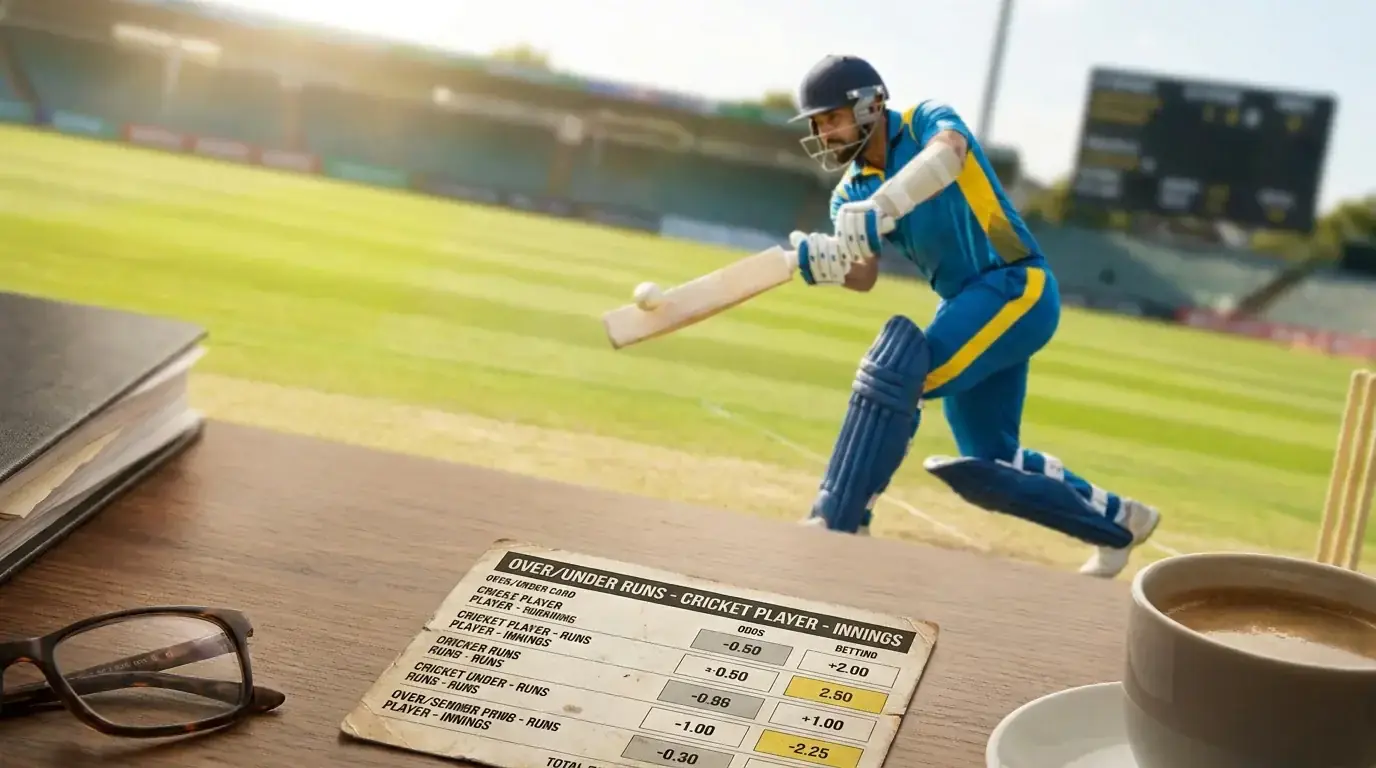
Over/Under runs lines are the workhorse. The trader sets a number – say, 32.5 runs for an England opener in a T20 – and you back over or under. The line is calibrated to be roughly Evens on both sides, which means the trader is genuinely trying to find the median outcome. That calibration is the value point. A player whose recent runs distribution has shifted higher than the trader’s model expects is structurally priced under his true expectation.
The interesting feature of Over/Under lines is how they respond to match state. A line set pre-match at 32.5 will move within a few balls of the start. If the player walks in at the toss and gets four balls of friendly seam, the line might jump to 38.5 by the end of the powerplay. If the captain opens with the spinner against him, the line might drop to 28.5. Live trading on player runs markets is one of the cleanest in-running edges in cricket – the market has to update by the over, not by the ball, and the gap between the displayed line and the live cricket is sometimes wide.
To Score a Milestone markets – “to score 50”, “to score 100” – are binary bets. The price is what it says: the operator’s view of the probability that this specific player passes that specific threshold. Milestone markets are less liquid than Over/Under lines because they’re binary, but they often have wider margins, which means more value when you find the right matchup.
Top Run Scorer per match is the market that draws the most attention from casual bettors and offers the worst structural value. Picking one batter out of eleven is hard, and the bookmaker’s overround on a Top Batter market typically runs at 115-120% – much wider than a Match Winner. Cricket fans place more bets than most people assume – 21% of UK cricket fans say they have placed an online sports bet in the past 12 months, only just behind football fans at 23% – and a large share of that volume goes through Top Batsman markets that aren’t priced as sharply as the Match Winner.
Player wickets markets
Bowler wicket markets work very differently to runs markets, because wickets are a discrete count with a fat-tailed distribution. A bowler taking four wickets in a 10-over ODI spell is uncommon. Taking five is rare. Taking six is once-a-tournament.
The most common bowler prop is Over/Under wickets – typically structured as Over 1.5 or Over 2.5 wickets in the innings. The line varies by bowler, format and conditions. A 1.5 line for a swing bowler with the new ball at Headingley in May is materially different to a 1.5 line for the same bowler at the Rose Bowl in July.

What makes bowler markets exploitable is the asymmetry of the distribution. A bowler’s wicket count has a high zero-rate. Many spells produce zero or one wicket. A handful produce three or more. The bookmaker has to set the line at a number that balances backers and layers, but the underlying distribution isn’t symmetric around that line. Backing Over 1.5 on a specialist bowler with strong matchup data against the opposition top order is structurally a positive-EV bet when you have a genuine conditions read.
Method of dismissal alongside bowler wickets is another corner worth knowing. “Bowler to take first wicket” markets are short on the new-ball specialists and long on second-change bowlers, but the actual first wicket distribution in modern white-ball cricket includes a meaningful share of run-outs and self-inflicted dismissals. Pure first-wicket pricing can drift past the realistic probability.
Career and tournament milestones
Milestone markets live across multiple time horizons. Single-innings milestones (to score 50, to take 5 wickets in an innings) are short bets settled within hours. Series-long milestones (Top Series Run Scorer) settle across weeks. Career milestones (first English batter to 12,000 Test runs, first bowler to 700 Test wickets) settle over years if at all.

The shortest-horizon milestones are where most UK betting volume sits. To Score 50 in a T20 match is priced as a binary, typically between 7/2 and 7/1 depending on the player and conditions. To Score 100 in a T20 is 14/1 to 33/1. To Score 50 in an ODI sits between 9/4 and 5/1 for a top-order specialist. These prices are set against historical data and adjusted for matchup, but they don’t always price live cricket – once a batter has reached 35 not out in twenty balls, the in-running price on 50+ should compress rapidly. Sometimes it does. Sometimes it doesn’t.
Tournament-long milestones are where I find the cleanest value. Top Tournament Run Scorer, Most Sixes in the Tournament, Most Wickets in the Tournament. These are season-long bets that reward you for spotting a player whose role and ground rotation gives them a structural advantage the market hasn’t fully priced.
When props get voided
The single rule that catches out new prop bettors: if the player doesn’t bat or doesn’t bowl, the prop is typically voided and the stake refunded. That sounds simple, but it has more variations than you’d expect.
A To Score 50 bet on a number seven batter who comes in at 280-6 and is on 45 not out when the innings declares – voided in most operator rule sets, because the player didn’t have the chance to complete the innings under normal conditions. A Bowler Wickets bet on a fourth seamer who bowls one over and pulls up with a hamstring strain – voided in most cases, because the bowling spell didn’t complete normally.
Rain-affected matches add another layer. A player prop on a match shortened by DLS is typically voided if the innings duration changes materially. The mechanics of UK cricket bet settlement when a match is abandoned covers these scenarios in more detail – different operators handle abandonment differently, and prop voiding is the area with the most operator-level variation.
Player rest is the modern wrinkle. Top players sometimes get rested mid-series for workload management. UK-licensed operators rate-limit or remove props on players whose availability is uncertain until the morning of the match. If you can’t find a prop you expected on the page, check the team sheet – it’s often pulled because of a confirmed or rumoured rest.
The flipside is that some milestone markets get pulled before the match even starts. A Top Series Run Scorer market on a player who picks up an injury during the warm-up will sometimes be removed entirely rather than re-priced. Operators do this to protect themselves from sharp punters who have better injury information than the trading desk. It’s frustrating to a casual punter, but it’s a sign of a market that’s working as intended.
Where the prop board pays attention
The honest summary is that prop markets reward research and punish habit. The deeper you go into a single fixture – pitch conditions, weather, recent form, head-to-head matchups, who’s likely to bowl what overs at what point – the more individual prop lines start to look mispriced relative to your read of the actual cricket. Casual bettors stake across the prop board hoping to catch one big number. Disciplined bettors pick two or three lines per match and stake them with conviction. The math, over a season, isn’t even close.