

The Birmingham ODI that changed how I price rain
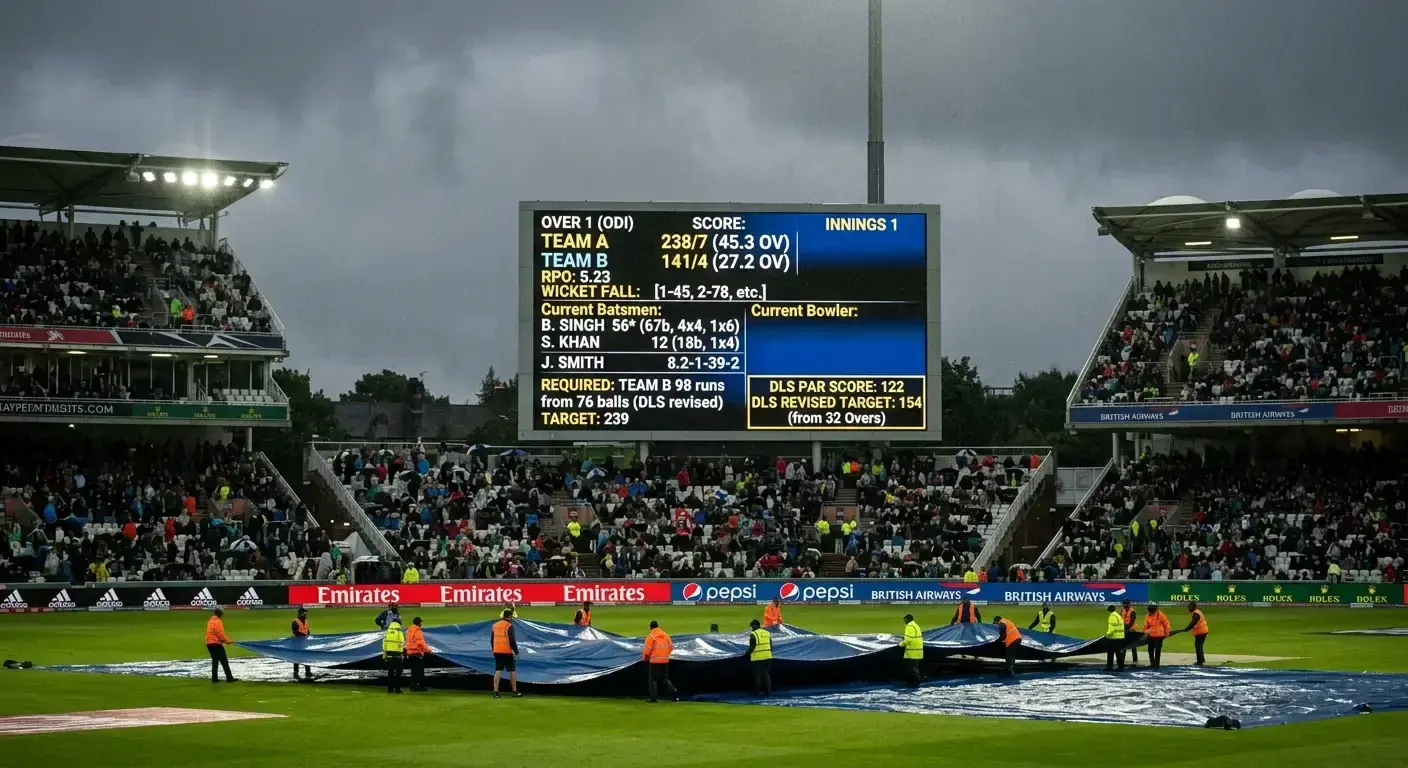
Edgbaston, an ODI a few summers back. England chasing 280 in 45 overs after an early rain delay, the DLS par score updating on the scoreboard every over. I had a bet on England to win straight up at 1.95 placed before the toss, and I watched the second rain break adjust the target down to 224 in 32 overs. The book updated the in-play price to 1.40, settled my pre-match bet as a winner once England crossed par, and I closed the laptop thinking I’d had a clean read. The next morning a friend who’d watched the same game asked me to explain why his “England to win” pre-match bet at the same book had settled differently. The difference turned out to be the specific market wording. He’d taken “match result” rather than “England to win,” and his book had treated the DLS-shortened match as a no-result for that specific market.
This piece is about how the Duckworth-Lewis-Stern method shapes cricket bet settlements at UK books, what punters actually need to know about par scores and target revisions, and where the rules around rain-affected matches differ in ways that matter for serious cricket betting.
What DLS actually does
The Duckworth-Lewis-Stern method is a mathematical formula used by the ICC and almost every cricket board to set fair revised targets when rain reduces the overs in a limited-overs match. It accounts for two resources – overs remaining and wickets in hand – and uses a precomputed table to determine what proportion of total resources each side had access to. The original Duckworth-Lewis was developed by Frank Duckworth and Tony Lewis and adopted by the ICC in 1999. The “Stern” addition came when Steven Stern updated the formula in 2014 to handle high-scoring T20 matches better. The current Professional Edition uses computer-calculated values rather than the published table for major matches.

The method assigns a par score to the chasing team at any point in their innings, based on how many overs they’ve faced and how many wickets they’ve lost relative to what the formula expects from a team chasing the original target with full resources. If they’re above par when the match is called off, they win. If they’re below par, they lose. If the match doesn’t reach the minimum overs threshold for a result – typically 20 overs per side in ODIs, 5 overs per side in T20s – the match is a no-result and DLS doesn’t apply.
The complexity for bettors isn’t the mathematics. It’s understanding when DLS produces a settlement-triggering result and when the match abandons before that point. Most UK books explain this clearly in their cricket terms: matches that reach the minimum threshold and produce a DLS result settle as completed matches; matches that don’t reach the threshold void. The line between these two states is what determines whether your bet wins, loses, or returns stake.
How par scores move during play
Live punters who follow DLS-adjusted matches see the par score on screen during rain breaks and resumed play, and the price reflects it. If England are chasing 280 in 50 overs and rain stops play at 35 overs with England at 195/4, the DLS par at that point – based on England having used 70% of their overs and lost 40% of their wickets – might be 198. England are below par by 3, and if play doesn’t resume the match settles as an Australian win by 3 runs on DLS. If the original target hadn’t been revised, the price would still reflect England’s chase position. With DLS applied, the price reflects the par-score gap.
I follow the par score during rain-affected ODIs the way I follow the required run rate during a clean chase. It’s the actual barometer of who’s winning the match. Below par means losing on DLS. Above par means winning. The required rate calculation has to factor in the new target and the new overs allocation if a resumption happens, which is why some operators publish updated required rates alongside the DLS par score during rain delays. The mathematical relationship is what allows experienced cricket bettors to trade positions in-play as conditions deteriorate.

The minimum threshold and what happens below it
The match has to reach a minimum overs threshold before DLS can produce a result. In ODIs, both teams need to bat at least 20 overs each (or be all out) for a DLS result to apply. In T20Is, the threshold is 5 overs per side. In domestic T20 competitions like The Hundred, the threshold is set per the competition’s own playing conditions and varies by tournament. If the match is abandoned before the threshold is reached, DLS doesn’t apply, the match is a no-result, and match-result markets at UK books typically void.
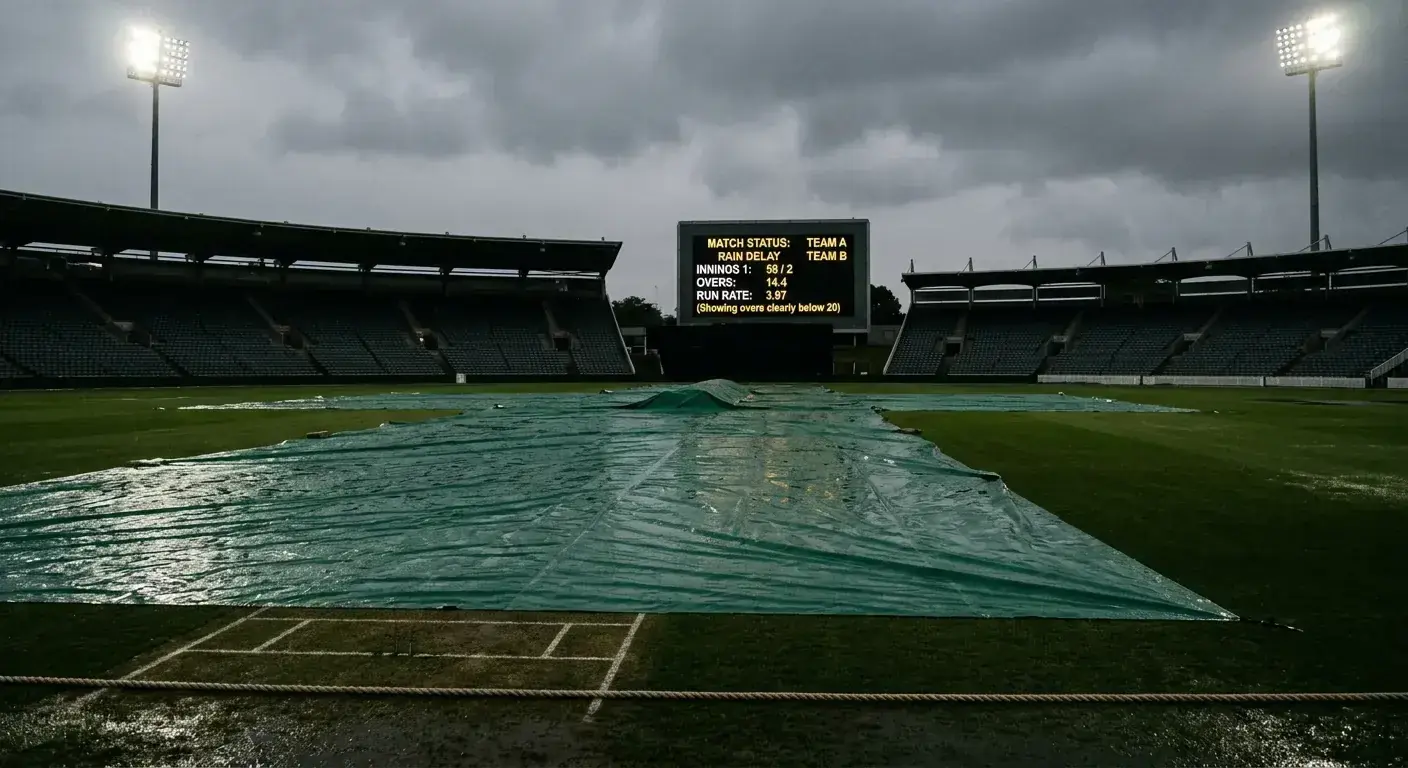
This is where the rules diverge between books. The standard treatment is that matches not reaching the threshold are voids – match winner, total runs, top batter, top bowler all settle as void with stakes returned. But individual markets that have been determined before the abandonment may still settle. The first ball six market settles the moment the first ball is bowled. The fall of first wicket method market settles the moment that wicket falls. These markets are determined-event markets, and DLS thresholds don’t unsettle them.
The Birmingham example I opened with is instructive. The match reached the threshold (more than 20 overs per side bowled), produced a DLS result with England chasing 224 in 32 overs and reaching the par score, and settled cleanly. If rain had returned before England reached par and pushed them below 20 overs faced after the original chase began – which can’t actually happen because they’d already faced more – the result would have applied differently. The interaction between overs faced and the DLS table is what determines the result, and the books that explain this clearly in their terms are easier to bet with on weather-affected matches.
The Stern revision and modern high-scoring matches
The “Stern” part of DLS matters more in modern cricket than the original Duckworth-Lewis design anticipated. The original formula was calibrated against ODI batting patterns from the 1980s and 1990s, and high-scoring matches – particularly chases of 300+ – sometimes produced revised targets that felt mathematically harsh on chasing teams. The 2014 Stern revision recalibrated the resource table to reflect modern T20 and ODI scoring patterns, where teams routinely chase 300+ and the scoring acceleration at the death of the innings is steeper than the original formula assumed.
For bettors, the practical implication is that DLS-revised targets in high-scoring matches are slightly more generous to chasers than they would have been under the original Duckworth-Lewis. A team chasing 320 in 50 overs that has the innings reduced to 32 overs by rain will face a revised target that reflects modern scoring expectations, not 1990s ones. This makes high-scoring rain-affected chases more competitive than the older formula would have produced.
I’ve seen this matter in IPL fixtures and in modern T20I cricket. The chase price under DLS-revised conditions reflects the team’s actual chance of catching the par score, not the deterministic position the old formula would have generated. Books that price live during DLS-affected matches generally factor the Stern revision into their pricing engines.
How specific markets handle DLS
Match winner markets settle on the DLS result if the threshold is reached. Total runs markets get complicated because the over reduction changes the run-scoring opportunity. Most UK books void total-runs markets in DLS-affected matches unless the line has been clearly determined before the rain. If the over/under is set at 280 total runs across both innings and the first innings produced 290, the over has already been determined and the market settles as a winner regardless of the truncated second innings.

Top batter and top bowler markets depend on whether both sides have completed their innings. A market where the first team batted through 50 overs and the second team is curtailed at 25 overs may settle on the top batter from the first team if no second-innings batter could mathematically catch them. Player props in DLS-shortened matches are particularly sensitive – a “Joe Root to score 50+” bet voids if Root hasn’t yet reached 50 when the match is curtailed, while a “Root scored 50+” bet settles as a winner if he reached 50 before curtailment.
The global growth context
The Edgbaston ODI was one fixture in a global cricket betting market that’s grown significantly. Recent industry research has placed the IPL as one of the most-bet-on cricket competitions, with the league’s broadcasting and betting ecosystem contributing meaningfully to a global cricket sport-betting market worth several billion pounds annually. ICC ACU figures around major events show that anti-corruption monitoring has expanded to handle the volume, with the ICC code effective from June 2024 covering players, coaches, officials and others across over 50 jurisdictions. The growth in monitoring has come alongside growth in legitimate ODI and limited-overs betting, where DLS settlement applies most often.
The market’s exposure to rain-affected matches is substantial. England’s summer schedule typically loses 10-15% of expected overs to weather across an average year. Asian markets in monsoon-affected months see comparable disruption. The volume of bets settled under DLS rules across a calendar year runs to millions of individual bets, and the rule clarity at UK Gambling Commission-licensed books has improved as a direct response to that volume.
Where DLS knowledge gives a betting edge
The edge from understanding DLS isn’t predicting whether it rains – the weather is what it is. The edge is in reading par-score positions correctly during rain delays and trading positions before the book updates prices to reflect the DLS reality. If England are above par at the moment play stops and the forecast suggests no resumption, the match is effectively over and the price should reflect that. If England are at par exactly, the result is in the balance and the price reflects the resumption probability. If England are below par with rain ongoing, they need the match to resume and the run rate to permit catch-up – a tougher position than the original chase implied.

The other edge is in selecting bets that interact well with DLS scenarios. Top-batter markets in matches with high rain probability are riskier than the price suggests because curtailment can void or settle the market on incomplete data. Total runs markets in rain-affected matches are price-sensitive to the threshold and the curtailment timing. Match-result markets are the cleanest because the DLS settlement is unambiguous once the threshold is reached.
How DLS shapes my rain-affected betting
The approach that’s emerged from years of trading rain-affected matches is to read the conditions before the bet, then re-read them constantly during the match. If the morning forecast suggests heavy rain at the death of the innings, the match is essentially a 30-35 over contest in disguise, and the markets should be priced on that basis. The book’s pricing engine may or may not have caught up to the weather reality, and the gap is where in-play opportunity exists.

Reading DLS without watching the scoreboard
The most useful summary I can offer is that DLS is a fair formula applied to an unfair situation, and the rules around its application to UK cricket bets are clearly published if you go looking for them. The match has to reach a minimum threshold to produce a settled result. The par-score relationship determines the winner once that threshold is passed. Specific markets behave differently within the DLS framework, and the variation between markets matters more than the variation between books.
The Edgbaston ODI that opened this article remains useful to me as a frame. The match was clean. The DLS rules applied cleanly. My pre-match bet settled cleanly. The friend’s bet settled differently because of a market-wording difference neither of us noticed at the time. The rules were there. The differences were there. The lesson – read the markets before you bet, not after – is the one most worth keeping.
